

By Kelvin Sin, Co-Founder of LiveFree · CEA Reg. No. R062804F
Last updated: July 2026
If you are house-hunting in the Beauty World belt with young children, the phrase bukit timah primary schools probably sits near the top of your search history — and it is also where most online guides quietly mislead you. The famous names people picture when they hear “Bukit Timah school belt” — Nanyang, Henry Park, Raffles Girls’ — mostly sit in District 10, several kilometres from Upper Bukit Timah. The schools actually within walking or short-driving distance of Beauty World and Jalan Jurong Kechil are a different, smaller set: Bukit Timah Primary, Pei Hwa Presbyterian Primary and Methodist Girls’ School (Primary), all in District 21.
Getting that distinction right matters more than it sounds, because Singapore’s Primary 1 (P1) registration is decided largely by how far your home is from the school gate — measured as a straight line, with a 30-month stay attached. Buy in the wrong pocket and the school you were counting on may sit just outside your priority band. This guide maps the D21 schools honestly, explains the 1km/2km mechanic, flags the ongoing Gifted Education Programme (GEP) reform, and gives you a proximity-planning checklist for a move to the Upper Bukit Timah area — including new launches such as The Sen on De Souza Avenue.
A note on figures up front: all distance bands below are indicative, drawn from property-marketing and aggregator sources rather than an official MOE measurement. Treat them as a starting point and confirm your own address on the MOE School Finder and OneMap before you commit to anything.
“Bukit Timah” is a long road and an even longer idea. It stretches from the city-fringe stretches of Bukit Timah Road proper, through Coronation and Sixth Avenue, all the way up to Beauty World and King Albert Park. Along that spine sit two quite different school clusters, and conflating them is the single most common mistake families make.
The District 10 cluster — think Nanyang Primary near Coronation, Henry Park off Holland Grove, Raffles Girls’ Primary, and the ACS family — is the prestige-belt image most people carry. These schools are genuinely elite and heavily balloted, but they cluster around King’s Road, Holland and Farrer, in postal districts 10 and 11. From Beauty World, they are typically outside the 2km band — which, as we will see, puts them in the lowest home-school-distance priority tier for a family living in Upper Bukit Timah.
The District 21 cluster is the one that genuinely serves the Beauty World / Upper Bukit Timah / Jalan Jurong Kechil pocket (postal sectors 58 and 59). It is smaller and less hyped, but for a family relocating here it is the set that actually counts: Bukit Timah Primary, Pei Hwa Presbyterian Primary and MGS Primary. This is also the belt that projects like The Sen draw on — the project sits in D21 off Jalan Jurong Kechil, within roughly a kilometre’s walk of Beauty World MRT (DT5).
One more geographic guardrail while we are here: Upper Bukit Timah is not District 23. Hillview, Dairy Farm, Bukit Panjang and Cashew — one MRT stop or two up the Downtown Line — sit in D23 (sectors 65–68). If a listing tags a Beauty World address as Hillview, treat everything else it says with suspicion.
Here is the honest map. The top three rows are the in-catchment D21 schools you can realistically plan around from the Beauty World belt. The bottom three are the celebrated D10 names — included precisely so you can see that they fall outside the typical 2km priority band from here, not because they serve this pocket.
| School | Address / area (District) | ~Distance band from Beauty World belt | Notes (type / affiliation / draw) |
|---|---|---|---|
| Bukit Timah Primary School | 111 Lorong Kismis, S598112 — Toh Tuck / Beauty World (D21) | Within ~1km of The Sen (indicative) | Govt, co-ed; historically a GEP centre (final P4 intake 2026 — see reform note); generally accessible balloting demand |
| Pei Hwa Presbyterian Primary School | 7 Pei Wah Avenue, S597610 — off Jalan Jurong Kechil (D21) | ~1–2km (reported ~2km) | Govt-aided; SAP (Chinese); Presbyterian church-affiliated; consistently oversubscribed / balloted |
| Methodist Girls’ School (Primary) | 11 Blackmore Drive, S599986 — near King Albert Park MRT (DT6) (D21) | Within ~2km (indicative) | Independent, girls’; affiliated to MGS (Sec) with an ACS(I) 6-year IP pathway; no standard GEP |
| Nanyang Primary School | 52 King’s Road, S268097 — Coronation (D10, not D21) | Outside ~2km of The Sen | Govt-aided, SAP; GEP centre; elite demand — listed to show it is not in the D21 catchment |
| Henry Park Primary School | Holland Grove Road (D10) | Outside ~2km | GEP centre; top-tier draw; D10, outside the Beauty World catchment |
| Raffles Girls’ Primary School | Hillcrest Road (D11/D10 fringe) | Outside ~2km | GEP centre, girls’; prestige belt — outside D21 |
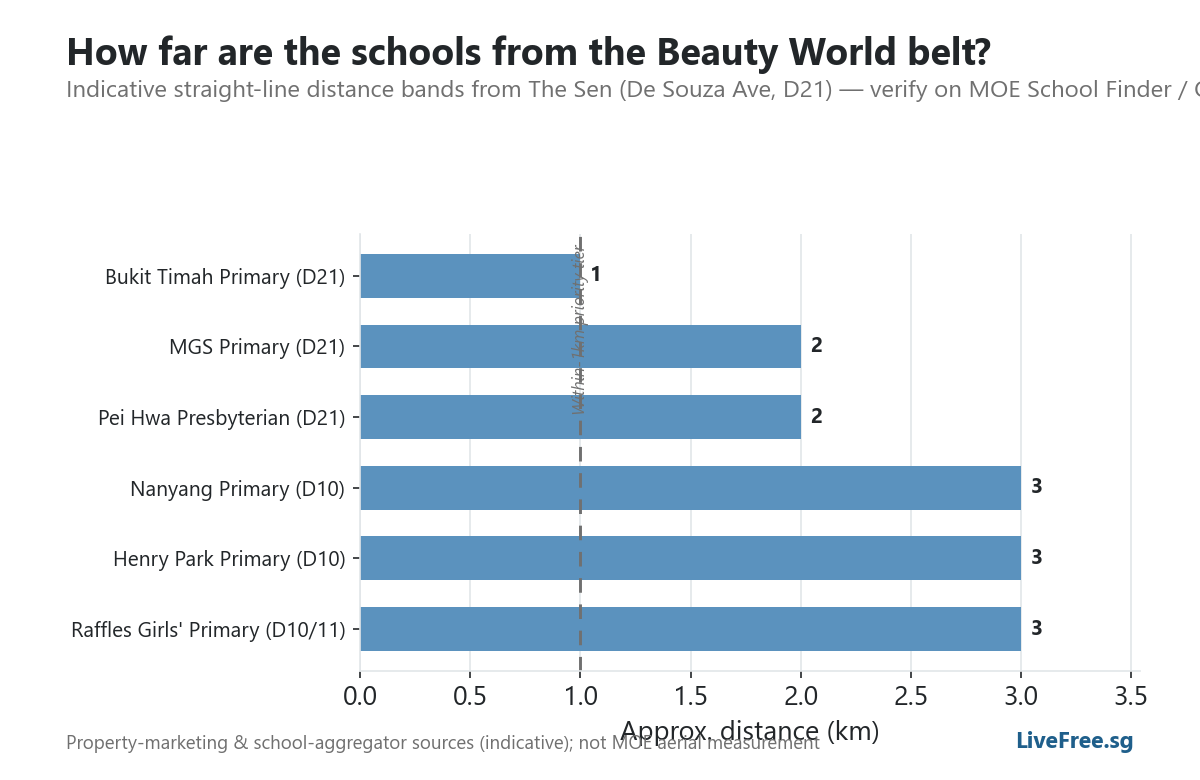
Distance bands are indicative only, relative to The Sen / De Souza Avenue, and drawn from property-marketing and school-aggregator sources — not MOE aerial measurement. Confirm exact eligibility on the MOE School Finder and OneMap.
The rest of this guide profiles the three in-lane D21 schools, then explains the mechanics that decide whether proximity actually converts into a place.
Of the three, Bukit Timah Primary School (111 Lorong Kismis, S598112) is the one most consistently described as being within roughly a kilometre of the Beauty World new-launch pocket, The Sen included — though again, that “within 1km” comes from property and aggregator sources rather than an MOE aerial calculation, so verify your specific unit’s address.
It is a government, co-educational school with a long-standing local reputation, and it has historically been one of the GEP (Gifted Education Programme) centres. That last point needs a careful caveat, which we unpack in full further down: the GEP is mid-reform, and the final P4 GEP-centre intake is 2026. From 2027 onwards, high-ability provision moves to a school-based model plus a set of designated module centres, so do not treat “GEP school” as a permanent, forward-looking feature of any school on this list.
On demand, Bukit Timah Primary is generally regarded as more accessible at P1 than the hyper-balloted D10 names — a meaningful plus if proximity is your main lever. As always, ballot outcomes shift year to year, so check the latest phase-by-phase vacancy and subscription data on the MOE portal before you bank on a comfortable entry.
Pei Hwa Presbyterian Primary School (7 Pei Wah Avenue, S597610) sits just off Jalan Jurong Kechil, squarely in District 21, and is reported to be around 2km from the Beauty World new-launch belt — placing it in the 1–2km band for many, but not all, addresses in the pocket. Because that band sits below the within-1km tier in P1 priority, the exact distance from your front door genuinely matters here.
Pei Hwa is a government-aided, co-educational school, and it carries two features that drive its popularity. First, it is a Special Assistance Plan (SAP) school, one of a small group offering an immersive bilingual, Chinese-heritage environment — a strong draw for families who want that grounding early. Second, it is Presbyterian church-affiliated, which opens an affiliation route in certain registration phases for eligible families.
The combination makes Pei Hwa consistently oversubscribed, with balloting reported in most phases. Aggregator sites rank it among the most in-demand primary schools in the west, though we would frame that as “reported to be among the most oversubscribed” rather than quoting a hard league position, since those rankings are not an official MOE metric. If Pei Hwa is your target, distance discipline and an early-phase strategy matter more here than at Bukit Timah Primary.
As a forward-looking aside that families sometimes miss: the Bukit Timah Integrated Development slated for the Beauty World area around 2028–2029 is expected to include an indoor sports hall associated with Pei Hwa Presbyterian Primary — a useful signal of the school’s continued anchoring in this precinct, though the components and timeline remain indicative.
Methodist Girls’ School (Primary) — MGS Primary — relocated to 11 Blackmore Drive (S599986), near King Albert Park MRT (DT6), and is therefore a genuine District 21 option, typically described as within roughly 2km of the Beauty World belt.
MGS is an independent, girls’ school, which shapes both its character and its admissions. As an established girls’ school with a strong academic and co-curricular tradition, it draws families from well beyond the immediate neighbourhood. Crucially for long-horizon planners, MGS Primary is affiliated to Methodist Girls’ School (Secondary) and offers an Anglo-Chinese School (Independent) six-year Integrated Programme (IP) pathway, a partnership running since 2013 — so the choice at Primary 1 carries a through-line all the way to a JC-equivalent qualification.
MGS does not run a standard GEP; instead it develops high-ability learners through its own school-based track. For a family specifically wanting a girls’-school environment inside the D21 catchment, MGS is the natural anchor — bearing in mind that, as an independent school, its admissions and fee structure differ from the government and government-aided schools above.
It is worth being blunt about the schools people most often ask about, because managing expectations here saves real money and heartache.
Nanyang Primary (52 King’s Road, Coronation), Henry Park Primary (Holland Grove Road), Raffles Girls’ Primary (Hillcrest Road) and the ACS(P) family are, without question, among the most sought-after primary schools in Singapore. They are also, without question, in District 10 (with Raffles Girls’ on the D10/D11 fringe) — not District 21. From an Upper Bukit Timah or Beauty World home, they typically sit outside the 2km band.
Why does that matter so much? Because in the phases where home-school distance decides ballots, an address outside 2km is in the lowest priority tier. You are not barred from applying to a D10 school from D21, but you are competing from the back of the queue for schools that are heavily balloted even among their own near-neighbours. If your heart is set on Nanyang or Henry Park, the honest advice is that you would need to live materially closer than the Beauty World belt to make proximity work in your favour — and even then, demand is fierce. For families upgrading to D21, the realistic, plannable set remains the three D21 schools above.
The mechanic that ties all of this together is MOE’s home-school-distance (HSD) priority. Understanding it is the difference between hoping and planning.
When a school is oversubscribed at a given P1 registration phase and a ballot is required, applicants are prioritised into distance tiers based on where they live relative to the school:
Within each of those bands, Singapore Citizens (SC) are prioritised ahead of Permanent Residents (PR). The distance used is the straight-line (“aerial”) distance from your registered home address to the school — not the walking or driving route — calculated by MOE using OneMap data. This is why a school that “feels” close by road can still fall in a less favourable band, and why you should always check the aerial figure rather than eyeballing a map.
The distance tiers apply from Phase 2B onward (the phase for children of parent-volunteers, community leaders and church/clan members affiliated to the school), and most decisively at Phase 2C, the open phase where the bulk of non-affiliated families register.
Two more rules make or break a proximity strategy:
The practical takeaway for a Beauty World buyer: if a specific school is your goal, aim for an address inside its 1km aerial radius, and be ready to hold that address for 30 months.
If you have been reading older aggregator pages, you have probably seen several of these schools flagged as “GEP centres.” That framing is now out of date, and getting it right is part of doing YMYL content properly.
MOE has announced a reform of the Gifted Education Programme. The headline changes, as we understand them:
The framework here is well established; the precise percentages, the exact number of module centres and the finer dates are best treated as indicative and confirmed against MOE’s own announcements. The bottom line for a family choosing a school in this belt: do not pick a school on the strength of a legacy “GEP centre” label alone. By the time a child entering P1 in the next couple of years reaches the upper primary years, the model they experience will be the new one. Choose on fit, distance and culture; treat the GEP history as background, not a forward promise.
Primary school is the near-term decision, but families who plan on a longer horizon often ask what the area offers further up the ladder. The Bukit Timah belt is unusually rich here, which is part of its enduring appeal to education-focused households.
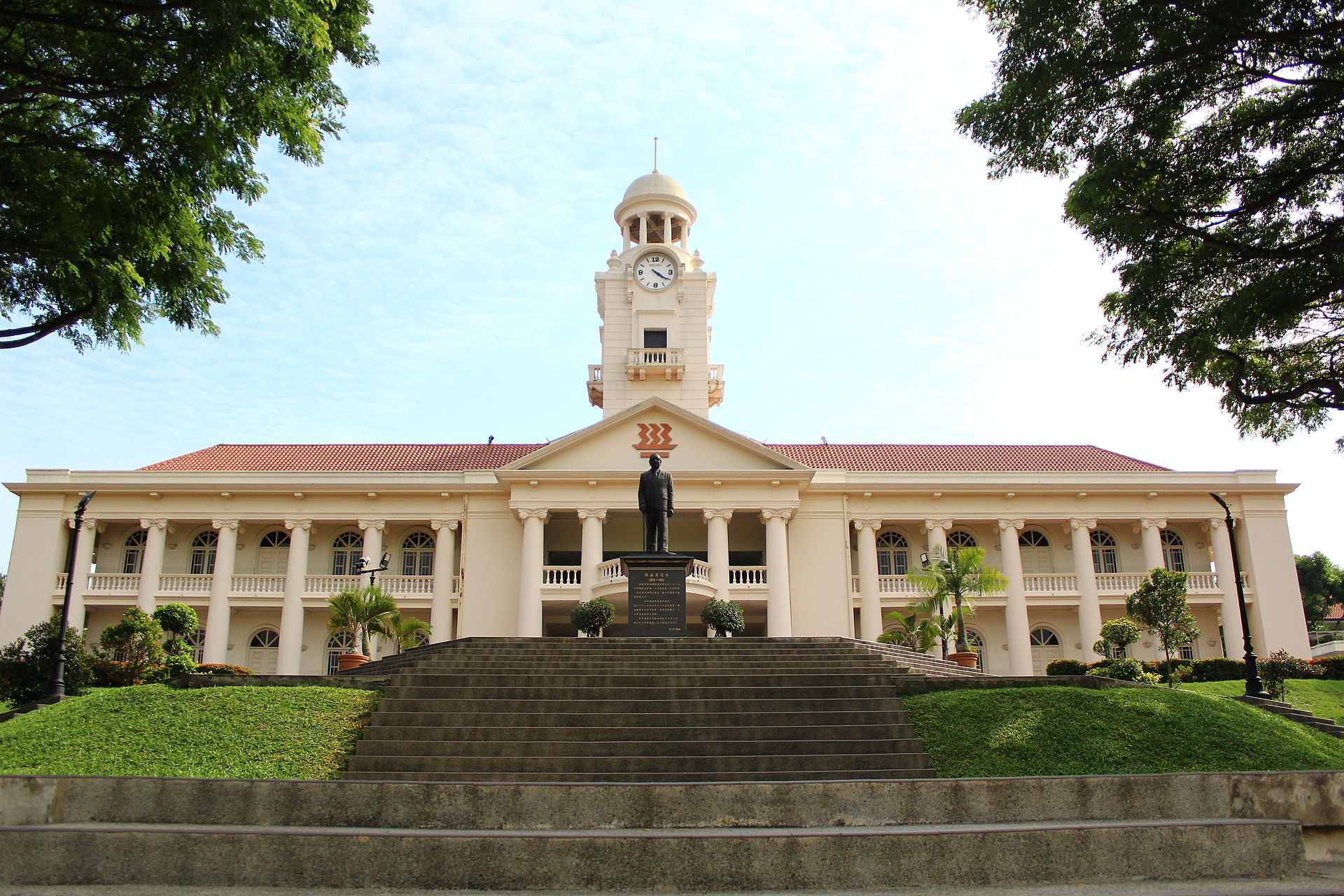
Within reach of Upper Bukit Timah sit some of Singapore’s best-known secondary schools and junior colleges: Hwa Chong Institution and National Junior College along the Bukit Timah Road spine, Singapore Chinese Girls’ School, and Nanyang Girls’ High in the wider vicinity. For families choosing MGS Primary, the built-in MGS Secondary affiliation and ACS(I) IP pathway provides a clear line of sight from P1 all the way through. None of these secondary institutions are proximity-balloted the way primary schools are — secondary posting works on the PSLE / posting system — but their presence reinforces why the Bukit Timah corridor holds its reputation as an education address across a child’s whole schooling.
If you are weighing a move to the Beauty World / Upper Bukit Timah pocket with P1 in mind, here is a practical sequence:
For families surveying the current crop of Beauty World-area homes against a school plan, our roundup of the 2026 top 5 new launches is a useful companion read, and the pillar guide to The Sen covers the project sitting closest to Bukit Timah Primary. As with everything above, treat distances as indicative and verify the specifics with official sources before you decide.
Is Bukit Timah Primary School a GEP school?
Historically yes — it has been one of the legacy GEP centres. But the GEP is being reformed: the last P4 GEP-centre intake is 2026, and from 2027 high-ability provision moves to a school-based model plus designated module centres. So treat “GEP school” as background history, not a guaranteed future feature, and confirm current arrangements with MOE.
Which primary schools are within 1km of Beauty World?
Bukit Timah Primary School (111 Lorong Kismis) is the one most commonly described as within roughly 1km of the Beauty World new-launch pocket. That figure is indicative and from property/aggregator sources — you must confirm the aerial distance from your specific address on the MOE School Finder and OneMap.
Is Pei Hwa Presbyterian Primary a SAP school?
Yes. Pei Hwa is a government-aided Special Assistance Plan (SAP) school with a Chinese-heritage bilingual environment, and it is Presbyterian church-affiliated. That combination makes it consistently oversubscribed, with balloting reported in most phases.
Are Nanyang and Henry Park primary schools in District 21?
No. Nanyang Primary (52 King’s Road, Coronation) and Henry Park Primary (Holland Grove Road) are in District 10, not District 21. From the Beauty World belt they typically sit outside the 2km home-school-distance band, which places you in the lowest priority tier for those schools.
How is the home-school-distance priority measured?
By straight-line (“aerial”) distance from your registered home address to the school, calculated by MOE using OneMap — not walking or driving distance. Priority runs within 1km, then 1–2km, then outside 2km, with Singapore Citizens ahead of PRs in each band, applied from Phase 2B onward.
How long must I live at my address to use it for P1 priority?
At least 30 months from the start of the P1 registration exercise. Registering with an address you do not genuinely occupy for that period does not qualify for home-school-distance priority.
Is Methodist Girls’ School (Primary) in the Beauty World area?
Yes — MGS Primary is at 11 Blackmore Drive, near King Albert Park MRT (DT6), in District 21, typically within roughly 2km of the Beauty World belt. It is an independent girls’ school with an MGS Secondary affiliation and an ACS(I) six-year IP pathway.
Disclaimer: Figures such as distance bands, school demand and GEP-reform details are indicative only, drawn from third-party and marketing sources and subject to change. This article is for general information and is not financial or property advice. Verify all school and eligibility details against official MOE sources and OneMap, and consult a CEA-registered agent before making any property decision.
Hi 
We offer private property consultations for readers. Interested?