

By Kelvin Sin, Co-Founder of LiveFree · CEA Reg. No. R062804F · Last updated June 2026
If you have ever looked at a condo and wondered why one development charges $280 a month while another asks for over $700, you are not alone. Condo maintenance fees in Singapore can feel like a black box, especially for first-time buyers moving up from an HDB flat where there is no equivalent monthly charge of this size. Yet these fees are one of the most predictable ongoing costs of condo ownership, and once you understand how they are built, you can estimate them before you buy and judge whether a development offers fair value.
This guide explains what condo maintenance fees actually are, how they are calculated using something called share value, what the money funds, and the typical monthly ranges you can expect by unit size and development type. We will use a large new launch, Thomson Reserve in District 20, as a relatable example of why bigger, fully facility-loaded projects tend to cost more to run.
Condo maintenance fees, often called MCST fees or the service charge, are the regular contributions every owner pays towards running and preserving the common property of a private residential development. Common property is everything you share with your neighbours: the pool, gym, lifts, lobbies, carparks, gardens, security gantries, corridors and the building structure itself.
In Singapore, these contributions are not arbitrary. They sit within a legal framework set out in the Building Maintenance and Strata Management Act (BMSMA), which governs how strata-titled developments are managed. Owners collectively form a Management Corporation Strata Title (MCST), the legal body that holds and spends these funds, usually with the help of a professional managing agent. The fees are typically billed quarterly rather than monthly, though most buyers think of them as a per-month figure when budgeting.
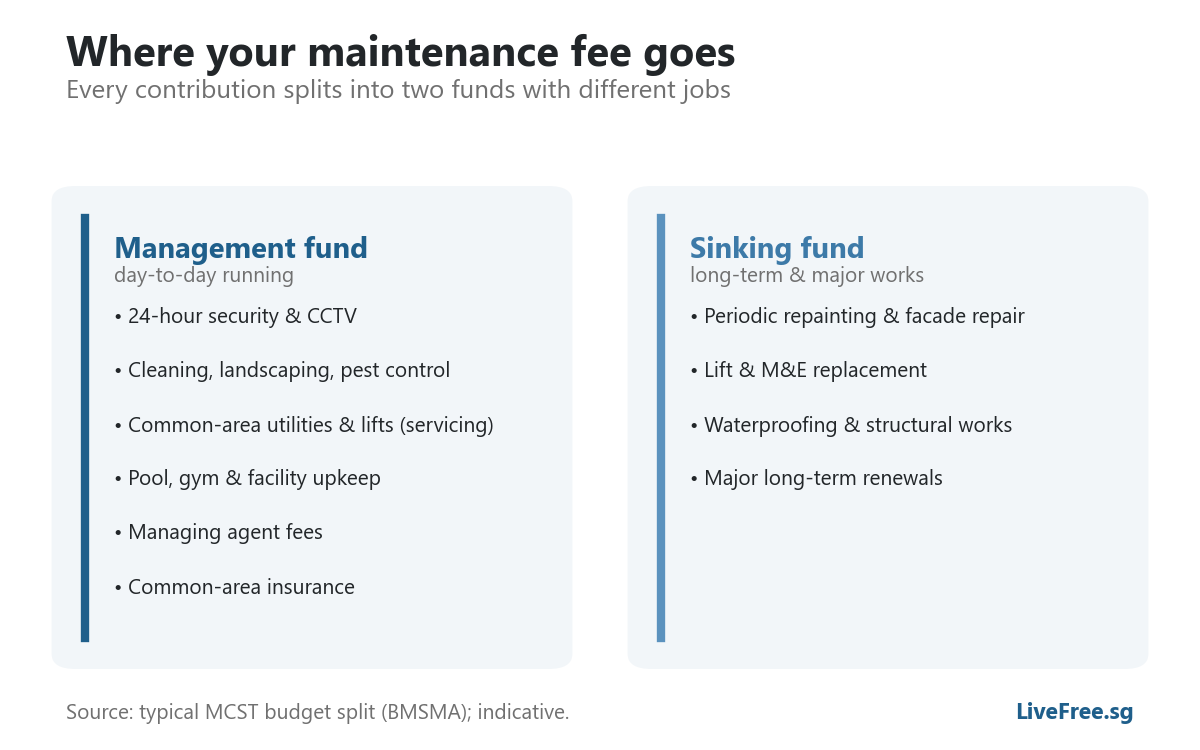
Your maintenance contribution is split into two separate pools, and understanding the difference matters when you assess a development’s financial health.
The management fund covers day-to-day operating costs. Think of it as the running budget that keeps the lights on, the pool clean and the security guards posted. This is the larger, more visible portion of your bill.
The sinking fund is the long-term reserve. It is a savings pot set aside for big, infrequent capital expenses, such as repainting the facade, replacing lifts, refurbishing the clubhouse, or fixing major waterproofing. Because these works can cost hundreds of thousands of dollars, the MCST builds the reserve gradually over many years so that owners are not hit with sudden, painful one-off levies. Under the BMSMA, MCSTs are required to maintain a sinking fund and make reasonable contributions to it; a well-run, well-funded sinking fund is one of the clearest signs of a healthy development.
When buyers ask why a 30-year-old condo can suddenly demand a special levy, the answer is almost always an underfunded sinking fund that could not absorb a major repair. This is why a low monthly fee is not automatically a good thing.
This is the part that confuses most people, so let us slow down.
Singapore condos do not charge a flat rate per unit, and they do not simply charge by square footage either. Instead, every unit is assigned a share value, a number that represents the unit’s proportionate stake in the development. Share value does two jobs at once: it determines how much you contribute to the funds, and it determines your voting weight at general meetings.
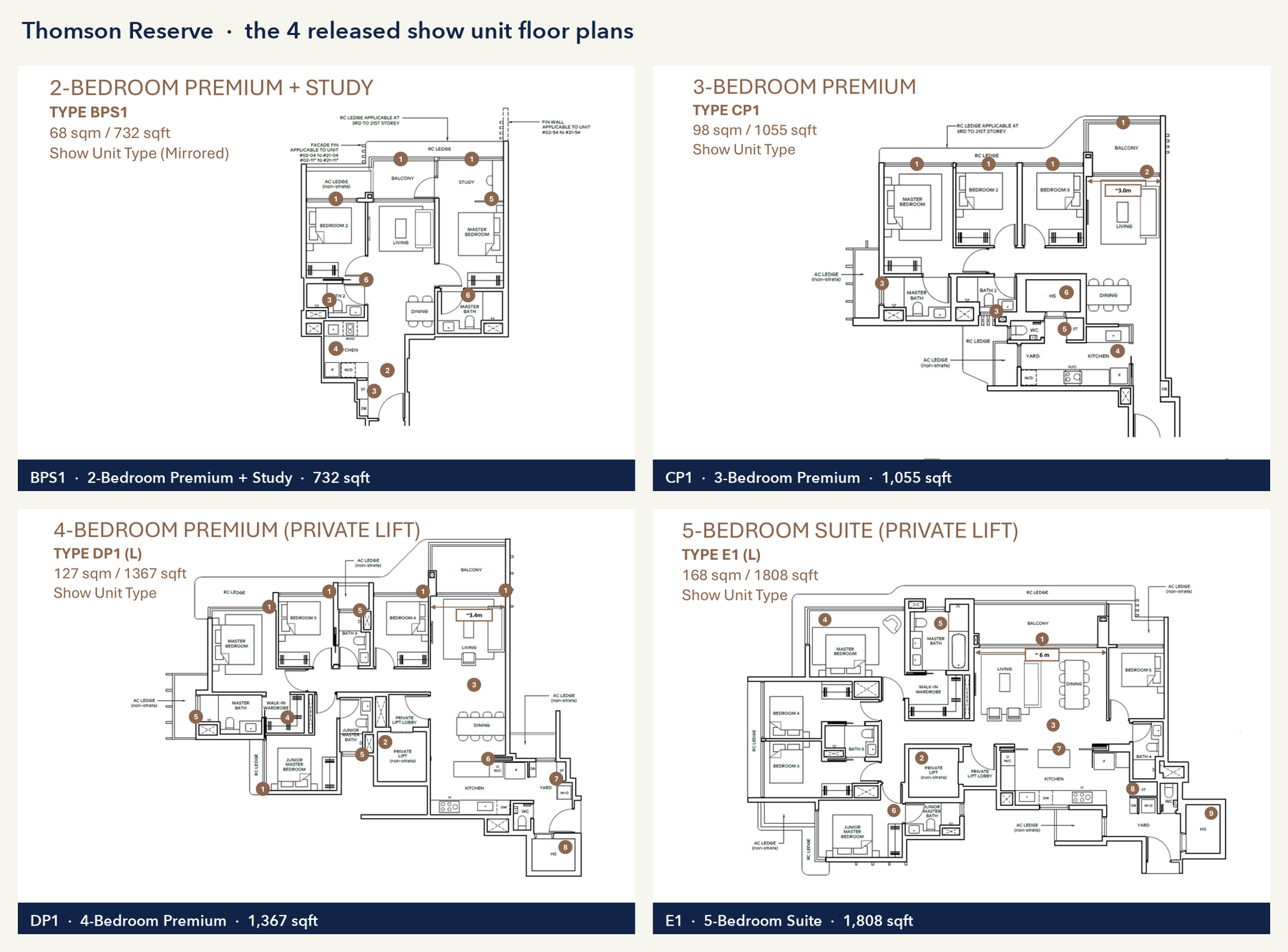
Share values are allotted by the Commissioner of Buildings, based largely on the floor area of each unit. As a general guide published by the Building and Construction Authority (BCA), a unit’s share value typically increases by 1 for every additional 50 square metres of floor area. So a compact one-bedroom unit might carry a share value of 5, while a large five-bedroom unit in the same project could carry 8 or 9. Larger units use more of the common resources and house more occupants, so they shoulder a proportionally larger share of the costs.
The formula for your contribution works like this:
> (Your unit’s share value ÷ Total share value of the whole development) × Total budgeted cost = Your contribution
For example, imagine a development with 5,000 total share values and a combined annual budget (management plus sinking fund) of S$5 million. That is S$1,000 of budget per share value per year. A unit with a share value of 6 would contribute 6 × S$1,000 = S$6,000 a year, or about S$500 a month. A larger unit with a share value of 8 in the same project would pay 8 × S$1,000 = S$8,000 a year, around S$667 a month, while a compact unit with a share value of 5 would pay about S$417 a month. This is the mechanism that distributes the budget fairly across units of different sizes.
A useful shorthand many buyers use is the dollar-per-share-value rate. Industry guides report that mass-market condos often run at around S$70 to S$80 per share value per quarter, which is a handy benchmark when comparing two projects.
It helps to see exactly where the money goes. The table below breaks down the typical cost categories funded by your monthly contribution.
| Cost category | Fund | What it covers |
|---|---|---|
| Security | Management | 24-hour guards, CCTV, access systems, guardhouse staffing |
| Cleaning & landscaping | Management | Common-area cleaning, gardening, pest control, refuse removal |
| Utilities (common areas) | Management | Lighting, pumps, lift power, water features, irrigation |
| Facilities upkeep | Management | Pool chemicals and servicing, gym equipment, BBQ pits, function rooms |
| Lift maintenance | Management | Routine servicing and inspection contracts |
| Managing agent fees | Management | Professional firm that runs accounts, contractors and the MCST |
| Common-area insurance | Management | Fire and public-liability cover for shared property |
| Repainting & facade | Sinking | Periodic external repainting and facade repair |
| Lift & equipment replacement | Sinking | Major renewal of lifts, pumps and M&E systems |
| Waterproofing & structural | Sinking | Large-scale roof, deck and structural repairs |
As you can see, security, cleaning and managing-agent costs make up the bulk of the recurring spend, and all three have been rising in recent years due to higher utility tariffs and wage increases under the Progressive Wage Model for cleaning, security and landscape workers.
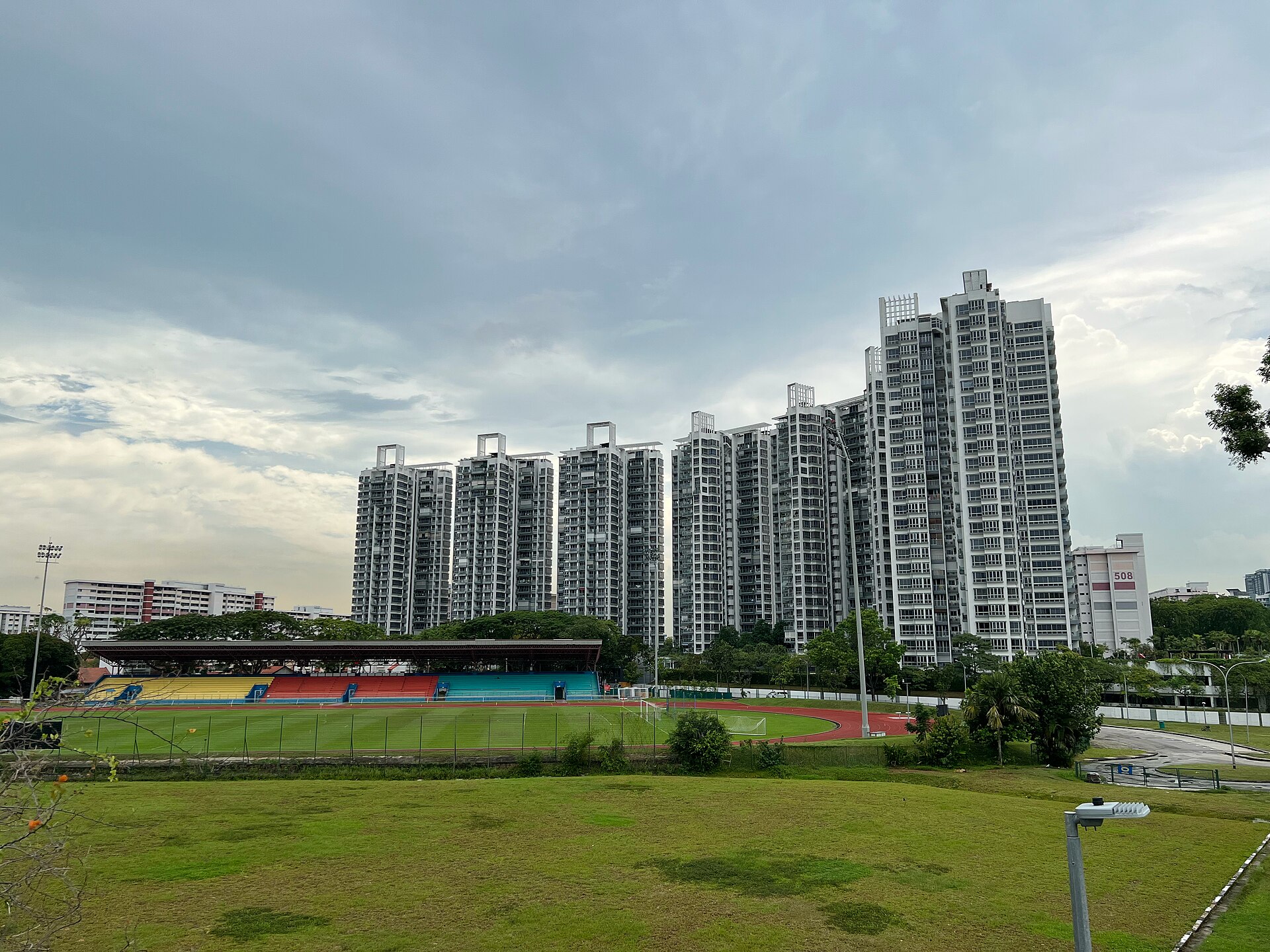
So what should you actually expect to pay? Based on figures reported across reputable property sources, most Singapore condos charge somewhere between S$300 and S$700 a month, with larger units and luxury or full-facility developments pushing past S$1,000. New launches generally sit a little lower at first, often reported in the region of S$270 to S$650 a month (typically quoted excluding GST), partly because fresh developments have minimal repair history.
The table below gives indicative ranges by unit type. Treat these as broad benchmarks, not guarantees, because the actual figure always depends on the specific development’s share value schedule, facilities and budget.
| Unit type | Indicative share value | Typical monthly fee (2026) |
|---|---|---|
| Studio / 1-bedroom | 5 | ~S$280 – S$450 |
| 2-bedroom | 6 | ~S$400 – S$550 |
| 3-bedroom | 7 | ~S$450 – S$800 |
| 4-bedroom | 8 | ~S$650 – S$1,000+ |
| 5-bedroom / penthouse | 9+ | ~S$900 – S$1,500+ |
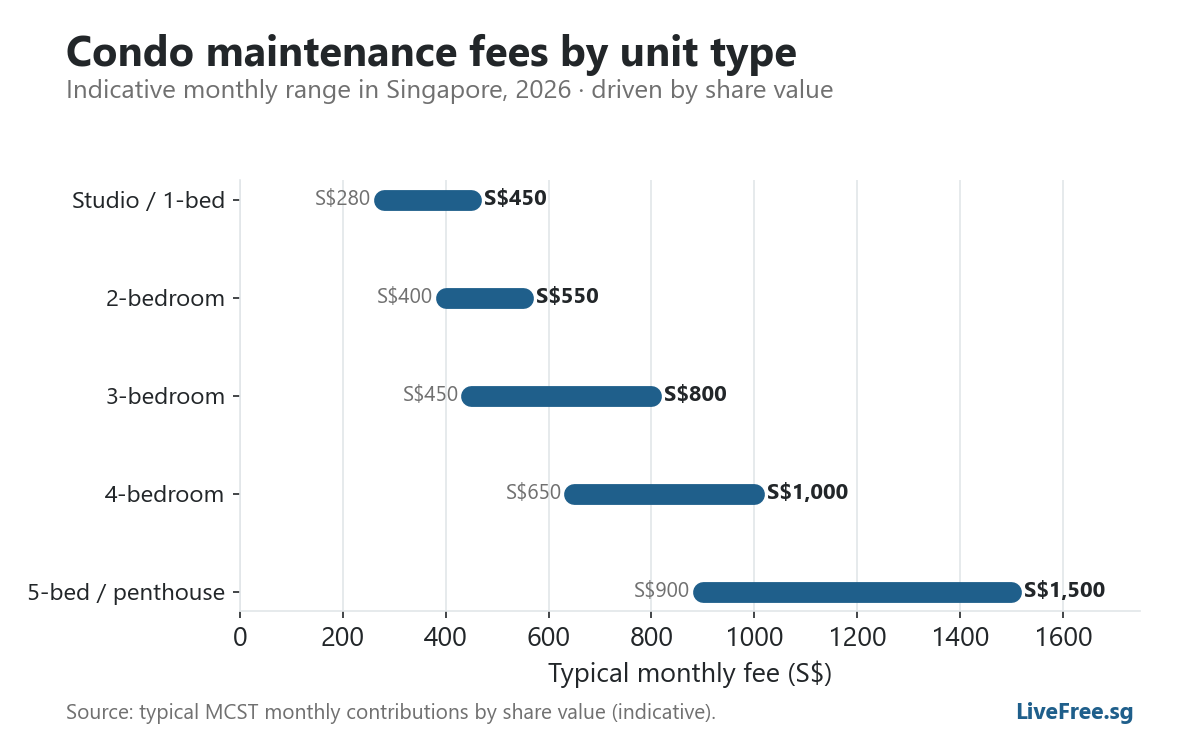
Figures are indicative ranges compiled from publicly reported Singapore market data and will vary by development. Always confirm the actual schedule of strata fees for the specific project.
Two practical takeaways. First, within the same development, your fee scales with unit size because larger units carry more share value. Second, between developments, the single biggest swing factor is the facilities count and the number of units sharing the cost.
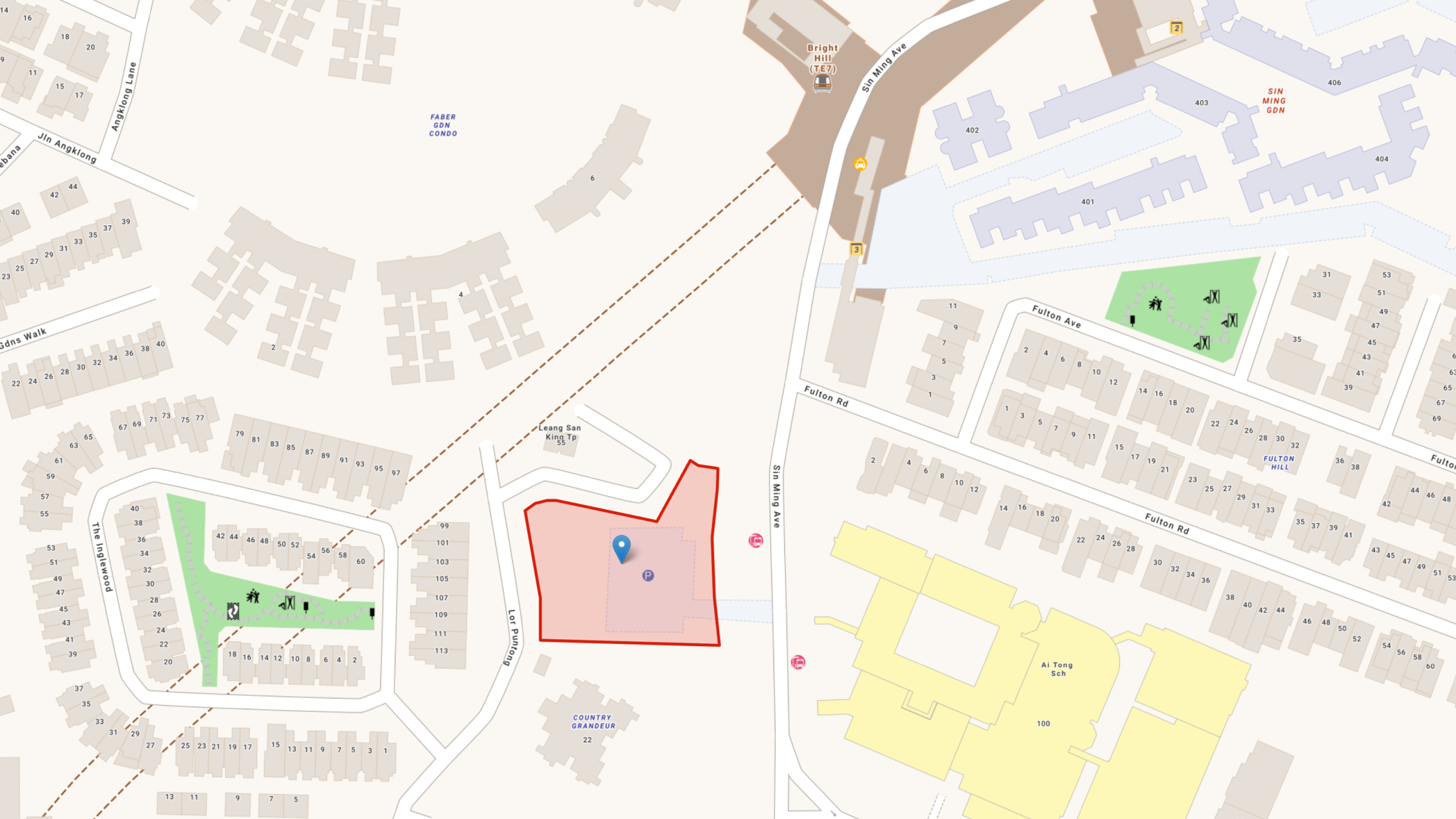
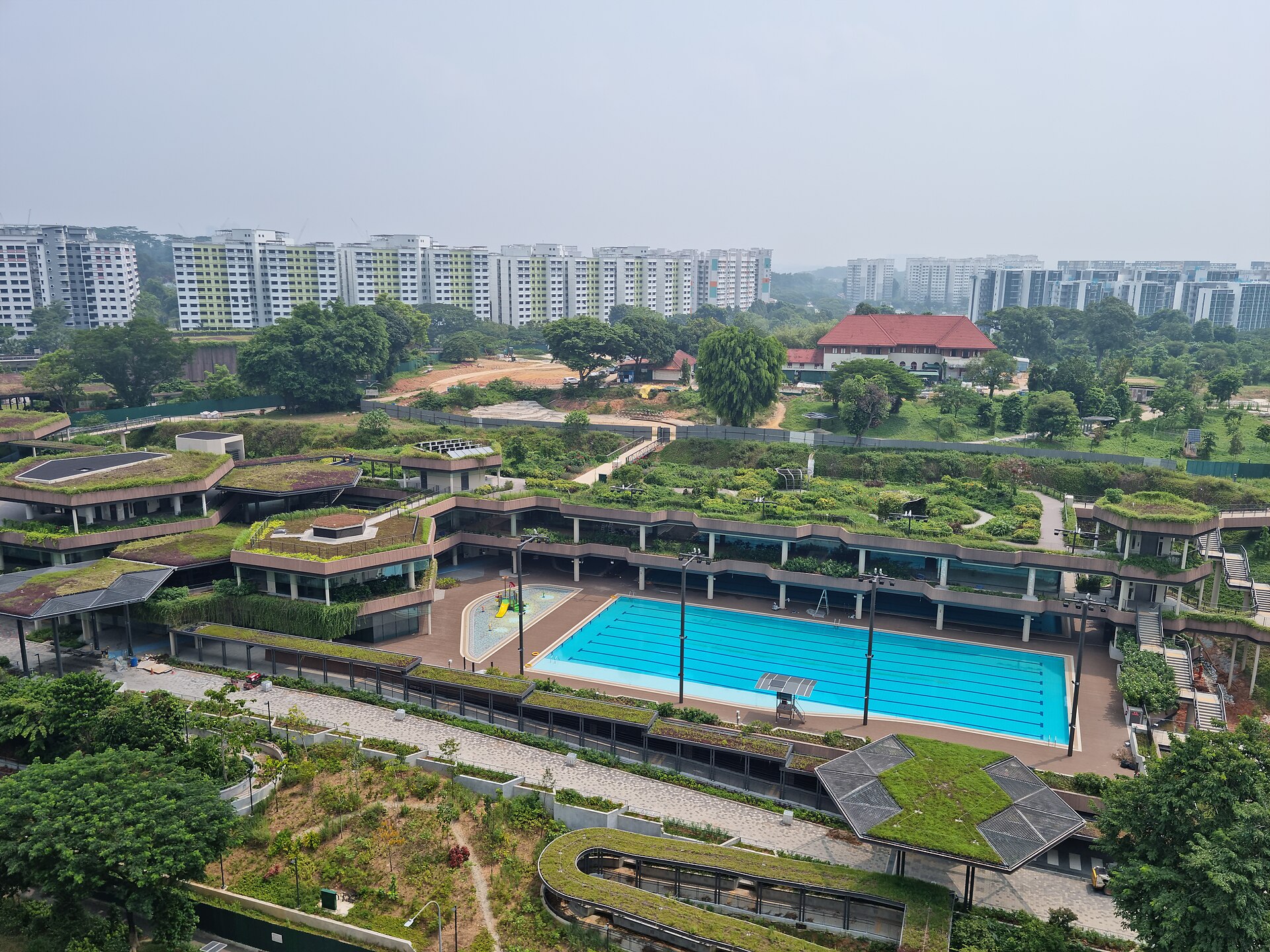
To make this concrete, consider Thomson Reserve, a large 99-year leasehold launch in District 20 a short walk from Upper Thomson MRT. It is a joint venture between UOL, CapitaLand and Singapore Land, with around 1,240 units and a deep facilities deck that reportedly includes a 50m lap pool, children’s pool, gymnasium, tennis court, clubhouse, yoga deck, steam room and co-working spaces.
A development like this illustrates the two competing forces that shape maintenance fees:
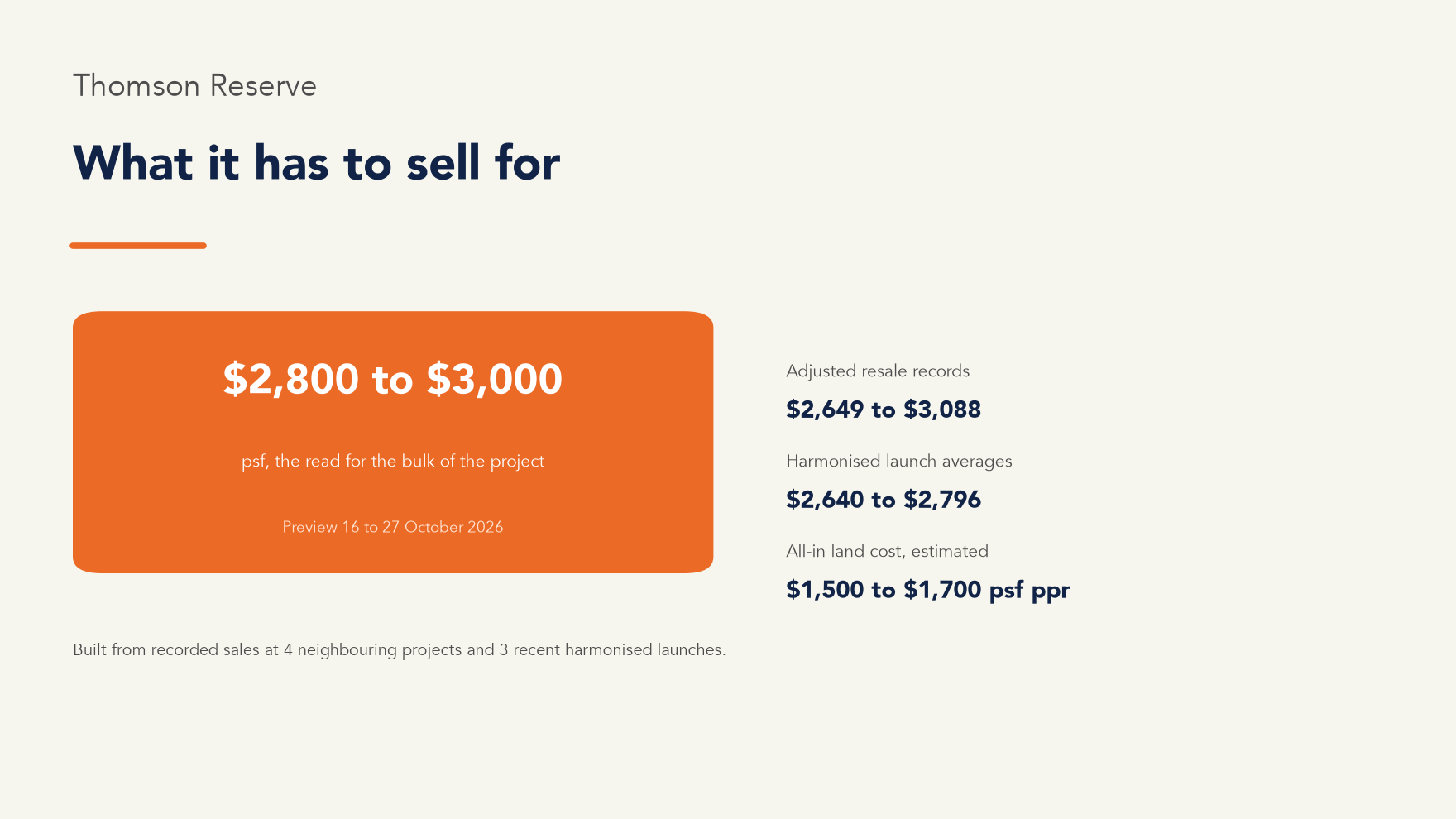
At the time of writing, the official maintenance fees and share value schedule for Thomson Reserve had not been confirmed, which is normal for a project still ahead of completion. Prospective buyers should ask the developer’s sales team for the indicative schedule of strata fees and check the share value assigned to the specific stack they are considering. For full project details, see our guide to the development, including the latest on Thomson Reserve maintenance fees.
This is a common point of confusion. Whether GST is added to your bill depends entirely on whether your MCST is GST-registered. An MCST must register for GST once its annual taxable turnover crosses the S$1 million threshold; many larger developments cross it, while smaller ones may not. If the MCST is registered, GST (currently 9 percent) applies to both the management and sinking fund contributions. If it is not, no GST is charged. This is why two friends in different condos can quote fees that look similar but settle at different final amounts.
A low fee is not automatically good, and a high fee is not automatically bad. Here is how seasoned buyers judge value:
Maintenance fees are best understood not as a tax, but as the price of keeping a shared asset in good condition, and ultimately of protecting your own property’s value. The cheapest fee is rarely the goal; the well-managed development is.
How much are condo maintenance fees in Singapore?
Most condos charge roughly S$300 to S$700 a month, with larger units and full-facility or luxury developments often exceeding S$1,000. New launches frequently start a little lower. The exact figure depends on your unit’s share value and the development’s budget.
How are condo maintenance fees calculated?
Each unit is assigned a share value, allotted by the Commissioner of Buildings and based largely on floor area (as a guide, increasing by about 1 for every 50 square metres). Your contribution is your share value divided by the development’s total share value, multiplied by the total budget.
What is the difference between the management fund and the sinking fund?
The management fund covers day-to-day running costs like security, cleaning, utilities and the managing agent. The sinking fund is a long-term reserve for major capital works such as repainting, lift replacement and structural repairs.
Do bigger units always pay more?
Within the same development, yes, because larger units carry a higher share value. Across different developments, the comparison depends on facilities and the number of units sharing the costs.
Is GST charged on condo maintenance fees?
Only if your MCST is GST-registered, which is required once its annual taxable turnover exceeds S$1 million. If registered, GST (currently 9 percent) applies to the contributions; if not, none is charged.
Why do new launches sometimes have lower fees?
New developments have little to no repair history and newer equipment, so early budgets can be leaner. Fees often rise over time as facilities age and contracts are renewed.
What is a special levy and how is it different from maintenance fees?
A special levy is a one-off charge the MCST raises when funds fall short of a major expense, typically because the sinking fund was underfunded. Regular maintenance fees are the ongoing scheduled contributions.
Can I refuse to pay maintenance fees if I do not use the facilities?
No. Contributions are a legal obligation under the BMSMA tied to your share value, regardless of how often you use the pool or gym. Non-payment can lead to interest charges and legal recovery action.
This article is general information, not financial or investment advice. Speak to a licensed property professional before making a decision.
Image credits: location photos via Wikimedia Commons – Jun Jie Yam (CC BY 4.0); Wzhkevin (CC BY-SA 4.0); Erwin Soo from Singapore (CC BY 2.0). Charts and infographics by LiveFree.sg.
Hi 
We offer private property consultations for readers. Interested?