

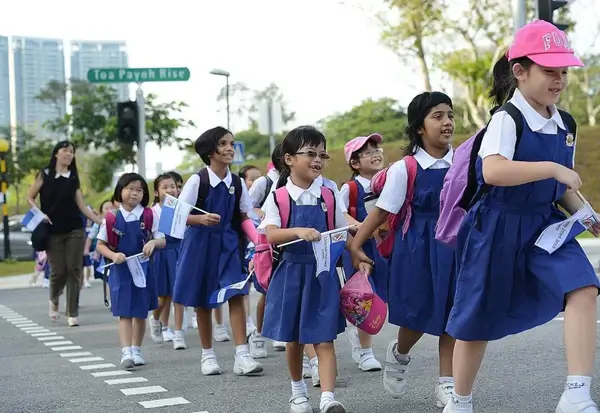
When parents search for the most popular primary schools in Singapore, they often start with familiar names such as Nanyang Primary School, Ai Tong School, Tao Nan School, Rosyth School, Catholic High School and CHIJ St. Nicholas Girls’ School.
However, the 2025 Primary 1 ballot history tells a broader story.
Several of Singapore’s best-known schools remained highly competitive. Yet the schools with the strongest overall demand were not limited to the usual names. Princess Elizabeth Primary School, South View Primary School, Gongshang Primary School, Nan Chiau Primary School and Nan Hua Primary School all received substantially more applications than vacancies.
For parents preparing for the 2026 Primary 1 Registration Exercise, popularity is not just about reputation.
It is also about:
This guide uses the 2025 Primary 1 ballot history to identify the most popular primary schools in Singapore. It ranks schools by their Subscription Rate, then groups them into three practical categories:
The aim is not to label one school as objectively better than another. Instead, it is to help parents understand where demand was strongest, how difficult a school was to enter, and how to build a more realistic school-registration plan.
For this article, schools are ranked by their Subscription Rate:
Subscription Rate = Total Applications ÷ Total Vacancies
For example, a Subscription Rate of 1.50x means that a school received around 150 applications for every 100 available vacancies across the registration exercise.
| School | Total Vacancy | Total Applied | Subscription Rate |
| Princess Elizabeth | 200 | 493 | 2.47x |
| South View | 270 | 516 | 1.91x |
| Gongshang | 240 | 450 | 1.88x |
| Nan Chiau | 300 | 544 | 1.81x |
| Nan Hua | 240 | 427 | 1.78x |
| Yangzheng | 160 | 268 | 1.68x |
| Temasek | 200 | 332 | 1.66x |
| Pei Hwa Presbyterian | 224 | 366 | 1.63x |
| Angsana | 280 | 435 | 1.55x |
| Rosyth | 270 | 407 | 1.51x |
The results show that school demand is not concentrated only in traditional central-school locations. Bukit Batok, Choa Chu Kang, Tampines, Sengkang, Clementi, Serangoon and Yishun all had schools that ranked among Singapore’s most subscribed primary schools in 2025.
But Subscription Rate is only one part of the story.
A high Subscription Rate is a clear sign that a school attracted strong overall demand. However, it does not tell parents their exact chance of securing a place.
A school may have a lower Subscription Rate because it has a larger intake, but still be difficult to enter if Phase 2C balloting reaches Singapore Citizens living within 1km.
Conversely, another school may have a high Subscription Rate overall, but remain more manageable for parents who live within 1km if the ballot does not reach that distance group.
This is why the schools below are grouped according to their actual ballot pressure, rather than reputation or Subscription Rate alone.
These are schools where:
For parents relying mainly on Phase 2C, these are the schools where even a 1km address may not provide certainty.
These are schools where Phase 2C remained tight, but ballot pressure was less persistent in the earlier phases.
This includes schools where:
These schools can still be viable choices, but parents should not assume that a 1km address automatically makes them safe.
“Accessible” does not mean unpopular, weak or undesirable.
It simply means that, based on the 2025 ballot history, the school did not face the same Phase 2C ballot pressure among Singapore Citizens living within 1km.
Many schools in this category were still popular and well regarded. However, the historical results suggest that families had a more practical route to admission compared with the two more competitive categories.
These are editorial categories based on the 2025 ballot history. They are not official MOE classifications, and demand, vacancies and ballot outcomes can change each year.
These schools faced the strongest registration pressure in 2025.
Every school below required Phase 2C balloting among Singapore Citizens living within 1km, and had already seen ballot pressure in Phase 2A or Phase 2B.
The list is arranged by the Phase 2C success rate for Singapore Citizens living within 1km, from lowest to highest.
| Phase 2A | Phase 2B | Phase 2C | ||||
| School | Balloting | Chances | Balloting | Chances | Balloting | Chances |
| Princess Elizabeth | SC<1 | 47% | SC<1 | 91% | SC<1 | 21% |
| Nan Hua | SC1-2 | 31% | SC<1 | 53% | SC<1 | 26% |
| South View | SC<1 | 43% | SC<1 | 80% | SC<1 | 28% |
| Northland | SC>2 | 67% | SC<1 | 71% | SC<1 | 32% |
| Chongfu | SC>2 | 57% | SC<1 | 53% | SC<1 | 32% |
| Nan Chiau | — | — | SC<1 | 42% | SC<1 | 33% |
| Rosyth | SC1-2 | 83% | SC<1 | 69% | SC<1 | 34% |
| Angsana | SC<1 | 66% | — | — | SC<1 | 36% |
| St. Hilda’s | — | — | SC<1 | 80% | SC<1 | 38% |
| Gongshang | SC<1 | 54% | — | — | SC<1 | 42% |
For parents without earlier-phase priority—such as sibling priority, alumni affiliation or parent-volunteer eligibility—the 2025 results show that these were among the most difficult schools to enter through Phase 2C.
Even for Singapore Citizens living within 1km, the success rate was below 50% at all 10 schools listed.
For example, a family targeting Princess Elizabeth, Nan Hua, South View, Northland, Chongfu, Nan Chiau or Rosyth should not assume that an address within 1km will automatically secure admission.
At schools in this group, it is sensible to have:
These schools did not show the same sustained ballot pressure across Phase 2A and Phase 2B. However, Phase 2C was still competitive enough for distance priority to matter significantly.
The schools below required Phase 2C balloting among Singapore Citizens living within 1km.
| Phase 2A | Phase 2B | Phase 2C | ||||
| School | Balloting | Chances | Balloting | Chances | Balloting | Chances |
| Hong Wen | — | — | — | — | SC<1 | 45% |
| Poi Ching | — | — | — | — | SC<1 | 49% |
| Chua Chu Kang | — | — | — | — | SC<1 | 57% |
| North View | — | — | — | — | SC<1 | 59% |
| Kuo Chuan Presbyterian | — | — | — | — | SC<1 | 63% |
| Elias Park | — | — | — | — | SC<1 | 65% |
| Northshore | — | — | — | — | SC<1 | 67% |
| Keming | — | — | — | — | SC<1 | 70% |
| Xinmin | — | — | — | — | SC<1 | 70% |
| Riverside | — | — | — | — | SC<1 | 76% |
These schools may look more manageable than the extremely competitive group, but a 1km address can still be important.
Families targeting Hong Wen, Poi Ching, Chua Chu Kang, North View or Kuo Chuan Presbyterian should not assume that living within 1km guarantees admission. The 2025 outcomes show that ballot pressure could still affect Singapore Citizens in the strongest distance category.
Parents should also take note of schools such as Paya Lebar Methodist Girls’ School, Bukit Panjang Primary School and St. Anthony’s Primary School. While they may not appear in the table above, families applying from the 1km-to-2km category faced particularly low success rates in Phase 2C.
The key is to understand your exact priority position, rather than treating any school as a “safe” choice based only on its reputation or location.
Not every family needs to target one of Singapore’s most competitive primary schools.
The 2025 ballot history also showed that many primary schools did not require Phase 2C balloting among Singapore Citizens living within 1km. For families without sibling, alumni or other earlier-phase priority, these schools may offer a more practical registration path—without needing to make a home purchase around one highly contested school zone.
However, “more accessible” should not be mistaken for “less desirable.”
Many of these schools are well-established neighbourhood schools with strong local communities, suitable programmes and convenient locations for families. The right choice should ultimately depend on your child’s needs, school culture, daily commute and the range of nearby alternatives—not just how difficult the school was to enter in one particular year.
We’re progressively publishing dedicated guides for every primary school in Singapore, including historical registration trends, balloting statistics, nearby condominiums and neighbourhood insights.
If you wish to know more about a Specific Primary School, you can write in to us at [email protected] or contact us via Whatsapp directly.
Understand the registration process, admission trends and historical balloting data across Singapore’s primary schools.
Explore the most popular primary schools across different parts of Singapore and compare admission trends within each region.
For many families, choosing a primary school and choosing where to live go hand in hand. If you’re considering moving to improve your admission chances, explore our neighbourhood and condominium guides located within 1km of Singapore’s most sought-after primary schools.
Hi 
We offer private property consultations for readers. Interested?