

By Kelvin Sin, Co-Founder of LiveFree · CEA Reg. No. R062804F
Last updated: July 2026
Upgrading from an HDB flat to a private condo in District 19 is one of the biggest financial moves most Singaporean families ever make, and it is far more than a matter of loving a showflat. The order in which you sell and buy, the Additional Buyer’s Stamp Duty (ABSD) you may have to front, and the loan you can secure once you leave the HDB financing regime all move the numbers by tens of thousands of dollars. This checklist walks a prospective upgrading HDB to condo District 19 buyer through every gate, in the order they matter, with the current rules and a worked D19 example.
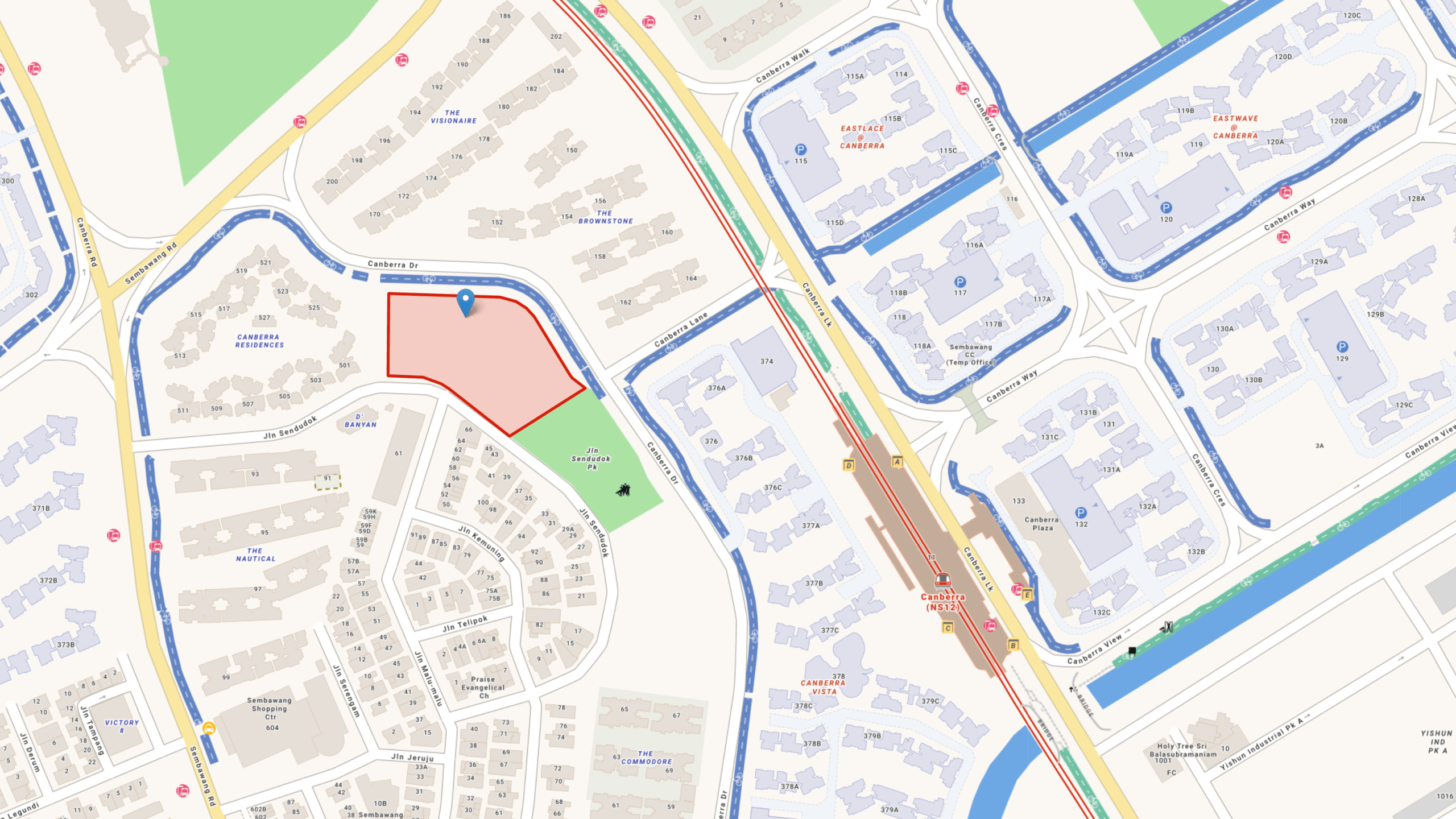
A quick note on geography. District 19 covers Serangoon Gardens, Lorong Chuan, Hougang, Punggol and Sengkang, and Lorong Chuan MRT is station CC14 on the Circle Line, within the Serangoon area of D19. So whether you are eyeing a resale condo in Serangoon or a new launch in the Lorong Chuan enclave, the checklist below applies.
Before any budgeting, confirm you are actually allowed to buy. Three gates decide this.
Gate 1 — Your HDB Minimum Occupation Period (MOP). For a standard HDB flat, the MOP is five years, counted from the date you collect keys and physically occupy the flat. If your flat is a Prime Location Public Housing (PLH) unit, the MOP is ten years. You cannot sell your flat on the open market, nor buy private property in the way described here, until the MOP is served.
Gate 2 — You cannot own private residential property during your MOP. HDB rules are explicit that flat owners must not acquire an interest in a private residential property during the occupation period. In practice this means the “buy the condo first, sell the flat later” strategy is only available after MOP is cleared — during MOP, you cannot hold both.
Gate 3 — You must dispose of your flat if you buy private and remain eligible. Once MOP is served you may keep the flat and buy private in most cases, but keeping both triggers the full second-property ABSD (more on that below), and specific flat types or grants can carry disposal conditions. Check your own flat’s conditions on the HDB portal before you commit.
Clear all three, and you are ready to think about money.
Everything downstream — how much ABSD you front, whether you need interim housing, how confident your budget is — flows from this single choice.
You sell your HDB flat, then buy the condo. Because the condo becomes your only residential property at the point of purchase, you pay 0% ABSD (a Singapore Citizen pays no ABSD on a first residential property). You also know your exact sale proceeds, so your budget is real rather than assumed. The trade-off is the interim-housing gap: you may need to rent, or negotiate an extended completion/lease-back with your buyer, between moving out of the flat and moving into the condo.
You secure the condo before your flat is sold. This locks in a unit you love — useful in a tight market or for a specific new launch — but at the point of purchase you already own the HDB flat, so the condo is a second property. A Singapore Citizen pays 20% ABSD on a second residential property, upfront, within 14 days of purchase. You then reclaim it through the married-couple remission once the flat is sold within the required window. Buy-first therefore demands a large temporary cash or CPF outlay and disciplined timing.
For most upgraders, sell first is the cleaner, cheaper route. Buy first is worth the ABSD float only when you genuinely cannot risk losing a specific unit — and remember the float is large: on a S$1.6m condo, the 20% you would front is S$320,000 in cash or CPF, held for months until the remission is refunded. If you are still weighing a brand-new project against a resale one, our companion piece on D19 new launch vs resale prices breaks down the price and timing differences.
ABSD is where upgraders lose the most sleep, so let us be precise.
The remission has firm conditions. The couple must be married; at least one spouse must be a Singapore Citizen; the second property must be bought in both spouses’ names only; and neither may have owned more than one residential property at the date of that second purchase. You must sell the first property — the HDB flat — and apply for the refund within the deadline.
Here is the timing trap most generic guides get wrong. The deadline to sell your first property is six months, but the clock starts differently depending on what you buy:
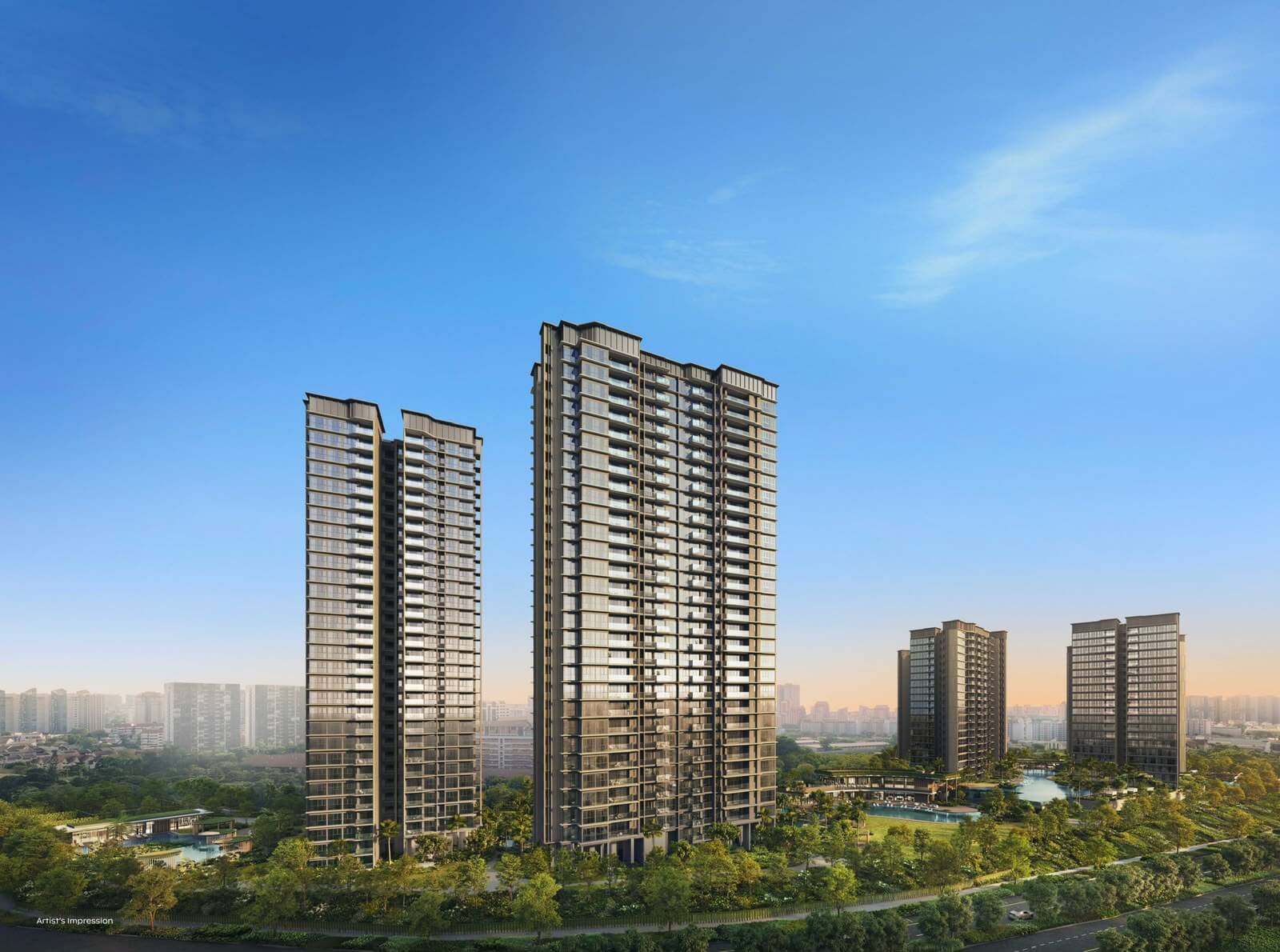
This distinction is material for a D19 upgrader choosing between a completed resale unit and a new launch such as One Chuan Grove, the Government Land Sales project in the Lorong Chuan enclave. With a resale unit your six-month selling window opens immediately; with an uncompleted new launch it does not open until the project reaches TOP, giving you far more runway. Always confirm your exact dates against IRAS before relying on either.
Leaving HDB financing changes your borrowing maths in two ways that catch upgraders off guard.
Your loan test switches from MSR to TDSR. HDB loans (and executive condominiums bought from a developer) are capped by the Mortgage Servicing Ratio (MSR): your monthly housing repayment cannot exceed 30% of gross monthly income. A private bank loan is governed instead by the Total Debt Servicing Ratio (TDSR): all your monthly debt obligations combined cannot exceed 55% of gross monthly income. TDSR is a wider net — it counts car loans, personal loans and credit-card commitments — so a family comfortable under MSR can find TDSR the binding constraint.
Loans are stress-tested. Banks assess your TDSR not at today’s rate but against a floor rate — currently around 4% per annum (confirm the prevailing floor at the time you apply, as MAS reviews it). Your income has to service the loan at that stress rate, not the teaser rate.
Loan-to-Value (LTV). If the condo will be your only housing loan, you can borrow up to 75% of the value or price (whichever is lower), provided the tenure is 30 years or less and does not run past age 65 — otherwise the cap falls to 55%. If you still have one outstanding housing loan (a buy-first scenario before your HDB loan is redeemed), the LTV on the new loan drops to 45%, or 25% for longer tenures or older borrowers. This is another reason sell-first is simpler: you clear the HDB loan first and preserve the full 75% LTV.
One further point catches resale buyers: if the bank values the unit below your agreed price — a cash-over-valuation situation — it lends only against the valuation, and you must top up the difference in cash. Get an indicative valuation before you commit your option fee, not after.
Beyond the loan, an upgrade carries a stack of one-off costs. Buyer’s Stamp Duty (BSD) is unavoidable and tiered; the rest are downpayment and transaction fees. The checklist below sets out each component, its rule, when it falls due, and whether it can be paid from CPF or must be cash.
| Cost component | Rule / rate | When due | Cash or CPF |
|---|---|---|---|
| Buyer’s Stamp Duty (BSD) | 1% to 6%, tiered by price (see below) | Within 14 days of exercising the OTP / S&P | Cash or CPF |
| ABSD (buy-first only) | 20% (SC second property); refundable via married-couple remission if the HDB is sold within six months | Within 14 days of purchase | Cash or CPF (reclaimed later) |
| Downpayment (min. 25% at 75% LTV) | 5% cash minimum, plus 20% from cash or CPF | At OTP / exercise | 5% cash + 20% cash/CPF |
| Housing loan | Up to 75% LTV, subject to TDSR 55%, stress-tested at a ~4% floor | On completion | Loan |
| Legal / conveyancing | ~S$2,500–S$3,500 (indicative — get quotes) | On completion | Cash or CPF |
| Valuation fee | ~S$300–S$500 (indicative) | Before the loan is granted | Cash |
| Agent commission (on HDB sale) | Typically ~1–2% + GST (market practice, not regulated) | On HDB sale | Cash |
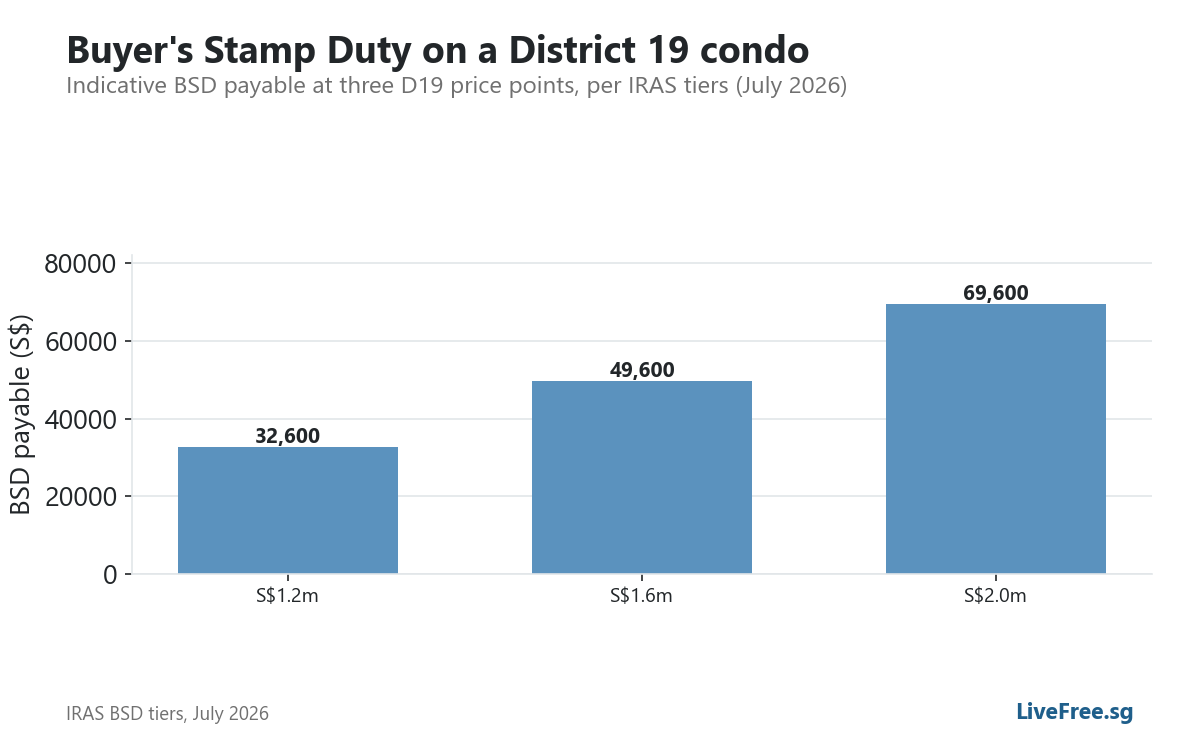
The BSD tiers, all confirmed on IRAS, are: 1% on the first S$180,000; 2% on the next S$180,000; 3% on the next S$640,000; 4% on the next S$500,000 (the S$1m–S$1.5m portion); 5% on the next S$1.5m (the S$1.5m–S$3m portion); and 6% on any amount above S$3m.
To make this concrete, here is an illustrative profile: a Singapore Citizen married couple, using the sell-first strategy, buying a District 19 resale condo. All figures below are indicative — the BSD calculation follows the fixed IRAS tiers and is the load-bearing part; the price and HDB sale value are illustrative inputs you should replace with live figures at the time you buy.
Assume a target D19 resale condo at S$1,600,000, roughly mid-band for D19 resale. (D19 new-launch pricing has recently been indicated in the region of S$2,100–S$2,600 psf across the district, with Lorong Chuan and Serangoon Gardens skewing to the higher end and Punggol/Sengkang lower — treat these as a range, not a point figure.)
| Item | Rule applied | Amount (illustrative) |
|---|---|---|
| Condo purchase price | — | S$1,600,000 |
| BSD | 1%×180k + 2%×180k + 3%×640k + 4%×500k + 5%×100k | S$49,600 |
| ABSD (sell-first) | 0% — condo is the couple’s only property once the flat is sold | S$0 |
| Minimum downpayment | 25% × S$1.6m (of which ≥5% = S$80,000 must be cash) | S$400,000 |
| Maximum loan | 75% × S$1.6m, subject to passing TDSR at the ~4% stress rate | S$1,200,000 |
The BSD alone is nearly S$50,000, and the downpayment S$400,000 — of which at least S$80,000 must be cash and the remaining S$320,000 can come from cash or CPF Ordinary Account. Your HDB sale proceeds (after redeeming any outstanding HDB loan and refunding your CPF with accrued interest) typically fund a large share of that downpayment, which is exactly why sell-first gives you a real, rather than hoped-for, budget. Model the net proceeds, not the headline sale price: the accrued-interest CPF refund in particular can be larger than owners expect on a long-held flat, and it reduces the cash actually available to move across. If your net proceeds fall short of the downpayment plus BSD, that funding gap is the number to solve before you sign anything.
A clean sell-first upgrade generally runs in this order:
If you buy first instead, you additionally front the 20% ABSD at purchase and must sell the flat within the six-month remission window (measured from purchase date for a completed unit, or from TOP/CSC for a new launch) to reclaim it. Some buy-first upgraders use a bridging loan to cover the timing gap between paying for the condo and receiving HDB sale proceeds — factor its cost in, and get the sequencing checked by your conveyancing lawyer.
A realistic sell-first timeline, from granting your HDB buyer an OTP to collecting the keys to your new condo, commonly spans a few months for a resale purchase, and considerably longer for a new launch under construction, where completion follows the developer’s build schedule. Build interim housing into that timeline early and treat its cost as a budget line item, not an afterthought.
District 19’s Circle Line connectivity is part of what draws upgraders here; if transport-driven value is central to your decision, our analysis of how the Cross Island Line affects District 19 property prices is a useful companion read.
Do I have to pay ABSD when upgrading from an HDB flat to a condo?
If you sell your HDB flat before buying the condo, the condo is your only residential property and a Singapore Citizen pays 0% ABSD. If you buy the condo before selling the flat, you pay 20% (SC second property) upfront and reclaim it via the married-couple remission, provided you sell the flat within the required window and meet all eligibility conditions.
How long do I have to sell my flat to get the ABSD refund?
Six months — but the clock starts differently. For a completed (resale) condo, the six months runs from your purchase date. For an uncompleted new launch, it runs from the issue of TOP or CSC, whichever is earlier. Confirm your exact dates with IRAS.
Can I buy a condo before my HDB MOP is up?
No. You must serve the Minimum Occupation Period first — five years for a standard flat, ten years for a Prime Location Public Housing flat — and you cannot hold private residential property during the MOP.
Why can I borrow a different amount now compared to when I bought my HDB flat?
Your loan test changes. HDB loans are capped by the 30% Mortgage Servicing Ratio; a private bank loan is capped by the wider 55% Total Debt Servicing Ratio, which counts all your debts and is stress-tested at a floor rate of around 4%. That, plus LTV limits, resets how much you can borrow.
What happens to my CPF when I sell the flat?
The CPF you used for the flat, plus the accrued interest you would otherwise have earned, must be refunded to your CPF Ordinary Account on sale. That refunded amount can then be applied towards the condo purchase, but it is not free cash in hand — plan around it.
Will I pay Seller’s Stamp Duty if I sell my new condo soon after buying?
Possibly. For residential properties bought on or after 4 July 2025, the SSD holding period is four years, at rates of 16% (sold within 1 year), 12% (1–2 years), 8% (2–3 years), 4% (3–4 years) and 0% after four years. Upgrading is a long-term move for most families, but if there is any chance you resell early, price SSD in.
Is Chuan Grove the same as Chuan Park?
No. Chuan Grove is a Government Land Sales new-launch project in the Lorong Chuan enclave of District 19. Chuan Park is a separate en-bloc redevelopment with a different developer and site. They sit near the same MRT station but are distinct projects — do not merge their prices or details.
Disclaimer: All figures are indicative and provided for general guidance only. This article is not financial or legal advice. Stamp-duty rates, loan limits and property prices change — verify the current figures against IRAS, MAS and HDB, and consult a CEA-registered agent, your bank and your conveyancing lawyer before acting on your own purchase.
Hi 
We offer private property consultations for readers. Interested?