

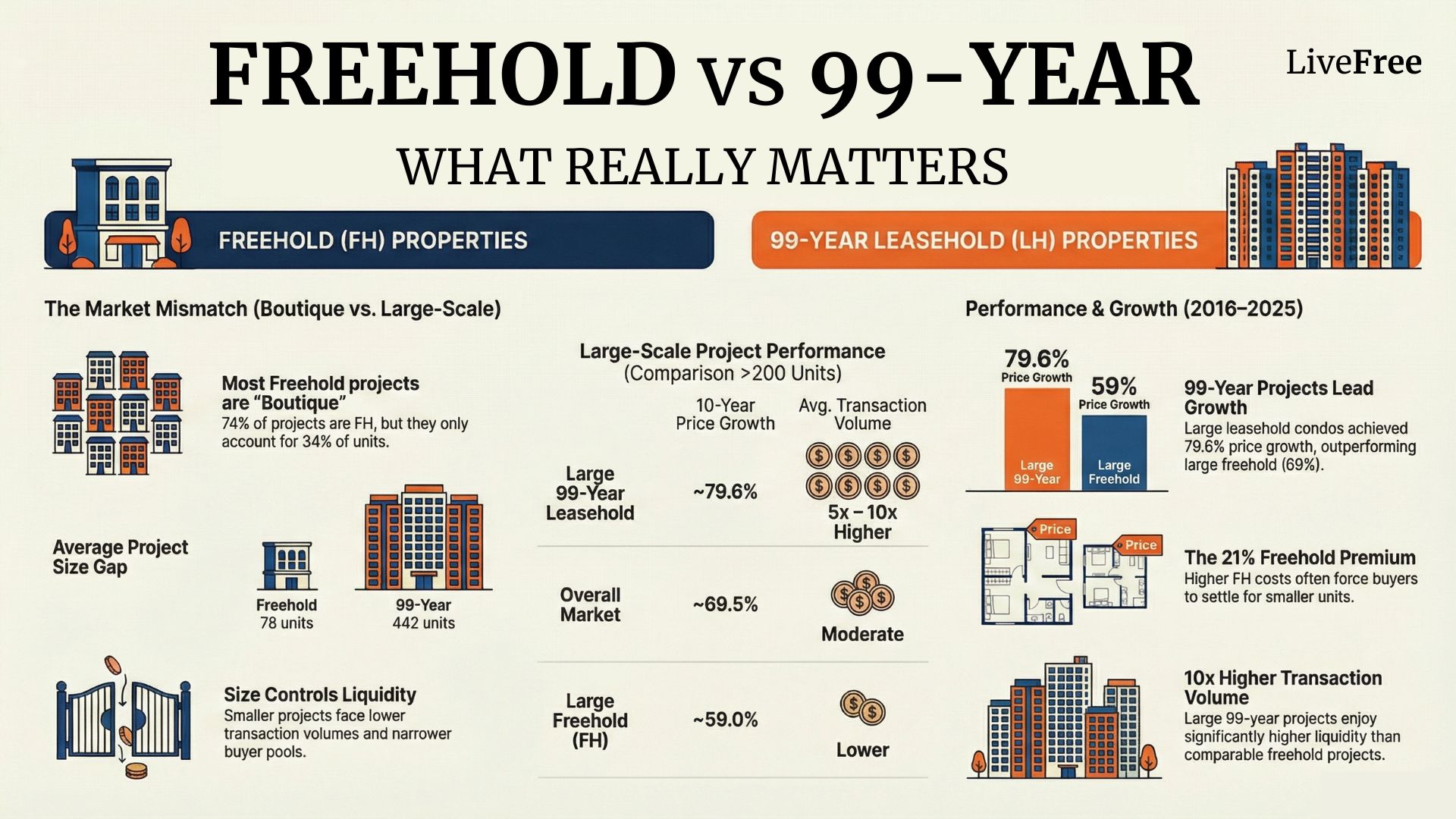
The 99 year vs freehold debate usually ends before it starts, because freehold sounds obviously better. The ten-year data says otherwise. Once you control for project size, large 99-year leasehold condos grew about 79.6% while large freehold grew about 59%, against an overall market at 69.5%.
In the 99 year vs freehold comparison, tenure alone does not determine returns in Singapore. What matters is who can buy the property, how often it trades, and whether demand stays deep enough for you to exit at a price you like.
The 99 year vs freehold instinct runs deep. Many buyers believe freehold protects value indefinitely and passes cleanly across generations without lease decay. That belief is why buyers accept a freehold premium even when it buys them a smaller unit, a less efficient layout, or a less liquid project.
But a longer tenure only answers one question: how long can value exist? It leaves the more important one untouched: will demand exist when you need to sell? Lease mechanics themselves are set out by SLA.
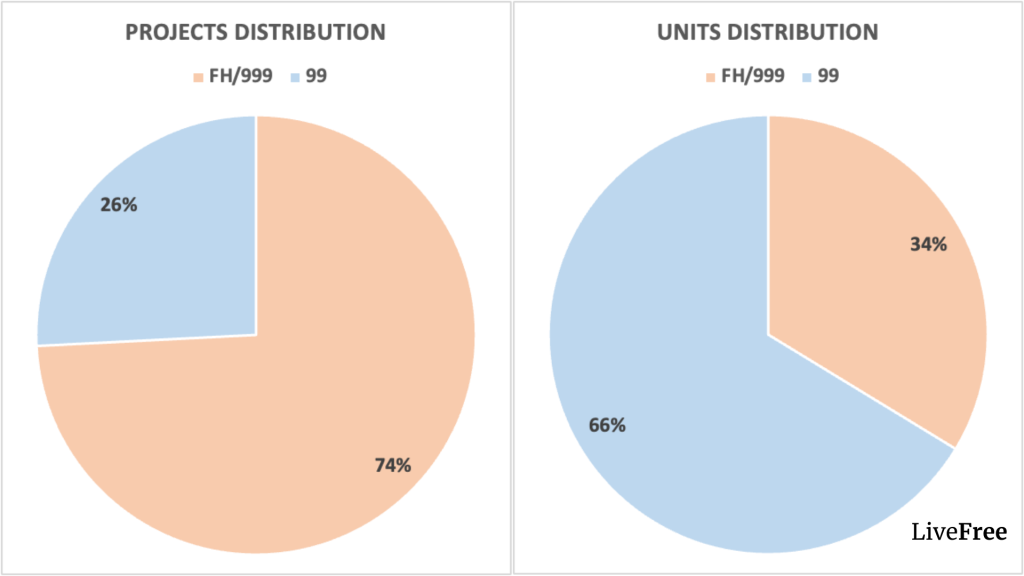
Across the private residential landscape:
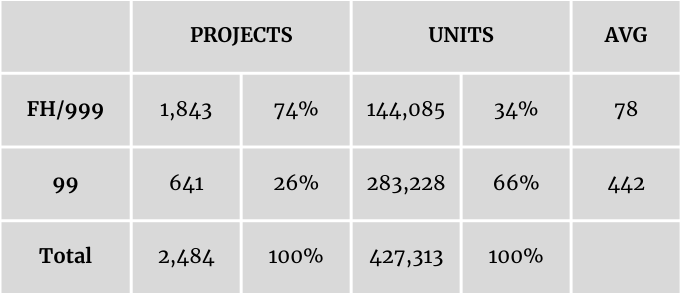
That imbalance is the whole 99 year vs freehold story in one line. Most freehold condos in Singapore are small boutique developments, and most large-scale projects are leasehold. Project size drives liquidity, buyer pool depth and resale behaviour far more than tenure does, as we set out in the truth about boutique condos.
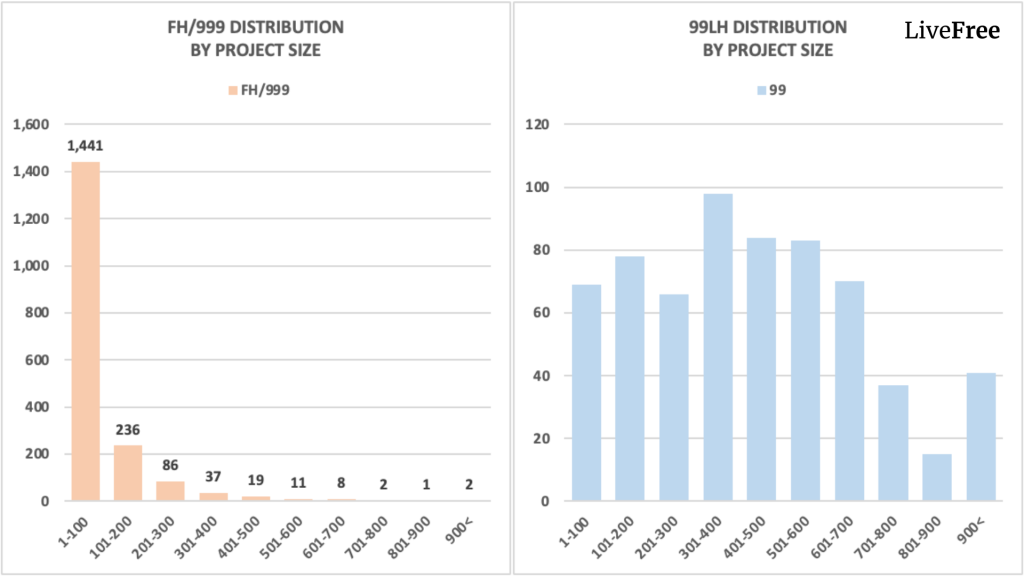
This is where most 99 year vs freehold comparisons go wrong. More than 90% of freehold and 999-year condos have fewer than 200 units. The average freehold condo in Singapore is, in practice, a boutique project.
Boutique developments historically face lower transaction volume, a narrower buyer pool, slower price discovery and longer holding periods before resale. That has led plenty of people to conclude boutique underperforms. Isolate the data properly and a sharper conclusion appears. To compare 99 year vs freehold fairly, you have to control for project size.
We separated boutique projects out of the freehold averages, then compared everything against two control groups: all freehold and 999-year projects, and the overall market.
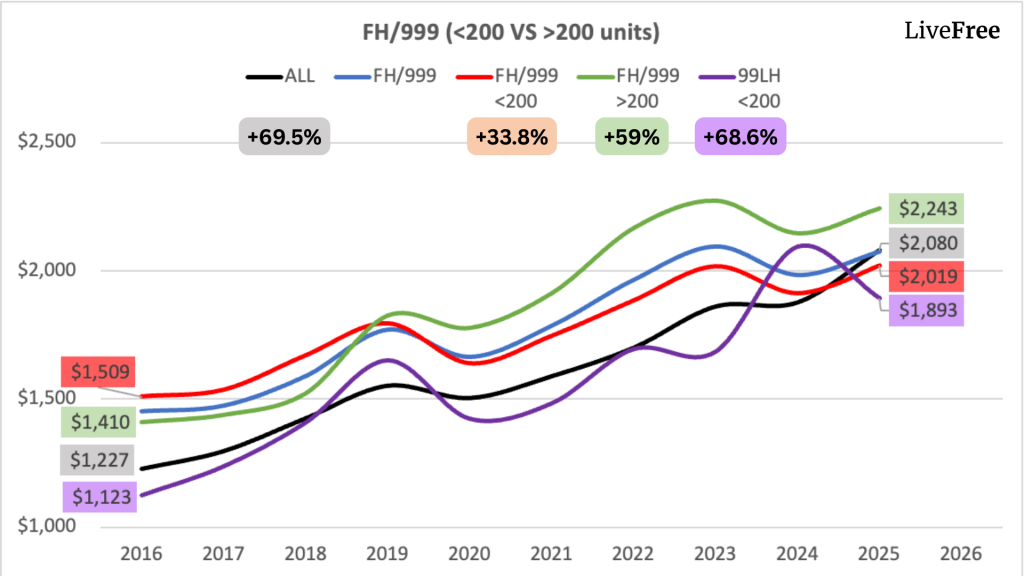
Freehold condos under 200 units started at higher prices because of the freehold premium, then delivered the weakest long-term growth. They underperformed every other category, including 99-year condos of similar size, larger freehold projects, and the market as a whole. Liquidity constraints, not market cycles, are what suppress this segment.
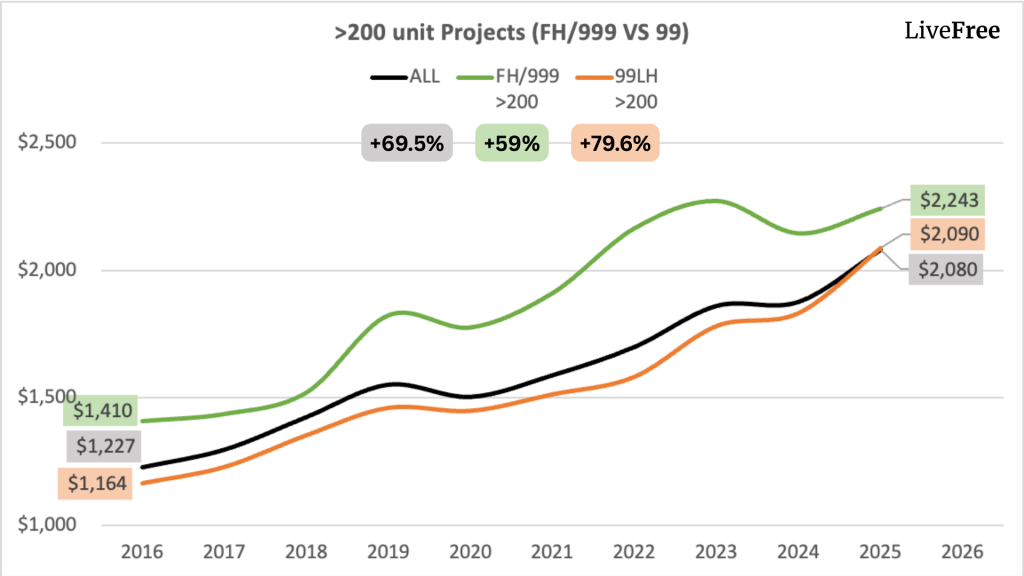
Freehold condos above 200 units do much better than small ones. Over ten years they achieved roughly 59% price growth against an overall private condo market at about 69.5%. Even with size no longer a disadvantage, freehold still failed to beat the broader market.
This is where the usual narrative breaks. 99-year leasehold condos under 200 units did not underperform. They performed in line with the overall market and beat both small and large freehold projects. Boutique, on its own, is not the problem. Small freehold is the anomaly.
Compared on equal footing, large 99-year leasehold condos achieved approximately 79.6% price growth, ahead of large freehold at about 59% and the overall market at 69.5%. Once project size is equalised, leasehold delivered the strongest performance in every segment.
Leasehold has historically been priced at a meaningful discount. In 2016, large 99-year condos averaged about $1,164 psf against large freehold at about $1,410 psf. That 21% premium has real consequences. On a $1.5 million budget in 2016, a buyer could take a 1,288 sqft 4-bedroom leasehold unit or a 1,063 sqft 3-bedroom freehold one.
In a market led by families and HDB upgraders, size and liveability routinely outweigh tenure. Our analysis of unit-type demand shows how strongly that preference has held.
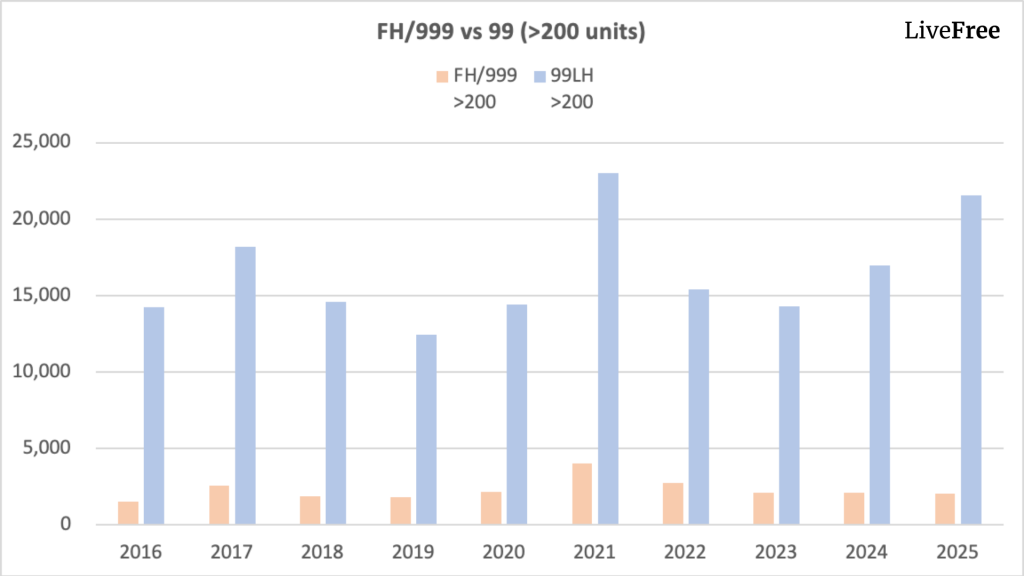
Large 99-year leasehold condos record 5 to 10 times more transactions than comparable freehold projects. Higher liquidity produces easier exits, more stable appreciation and better market visibility. Freehold condos rarely crash, but plenty stagnate quietly on thin turnover.
Leasehold projects attract HDB upgraders, family homebuyers and mass-market demand. Freehold relies on private homeowners, legacy-driven buyers and a narrower affordability band. A smaller buyer pool caps upside regardless of tenure, which is the same constraint we found across districts over ten years.
Strip the 99 year vs freehold argument back and it reduces to this. Tenure affects how long value can last. Demand decides whether value exists at all.
Banks do not treat freehold more favourably in financing, and buyer affordability still caps resale prices. The collective sale route that many freehold owners count on is rarer than assumed, which we covered in our en bloc data analysis. If legacy and land are the real objective, landed property answers that better than a boutique freehold condo does.
The wrong question in any 99 year vs freehold decision is whether freehold beats leasehold outright. The right ones are narrower:
The best condo investment in Singapore is not defined by tenure. It is defined by demand, affordability and exitability. Where those line up, our 2026 launch shortlist is a reasonable starting point.
Not on the ten-year data. Run the 99 year vs freehold comparison controlling for project size and large 99-year leasehold condos grew about 79.6% against large freehold at about 59%. Freehold protects duration; leasehold projects tend to have the liquidity.
Over 90% of freehold projects have fewer than 200 units, which means thin transaction volume, weak price discovery and conservative bank valuations. Small leasehold projects of the same size performed in line with the market, so size alone is not the cause.
No. Banks do not treat freehold more favourably, and buyer affordability continues to cap resale prices either way.
It was about 21% in 2016, which on a $1.5 million budget was the difference between a 4-bedroom leasehold unit and a 3-bedroom freehold one. For families that trade rarely favours freehold. For rental strategies, read our rental yield guide first.
It is real and it accelerates past the halfway mark, which is why entry age matters as much as tenure. For upgraders sequencing a move, our HDB upgrading roadmap and the 2025 market review cover the timing.
Weighing a freehold premium against a larger leasehold unit? Contact Kelvin on WhatsApp — a question costs nothing.
Hi 
We offer private property consultations for readers. Interested?