

A boutique condo in Singapore is usually sold on exclusivity, privacy and design. The data tells a less flattering story: as a group these projects are structurally less liquid, harder to value, and slower to exit. That is not a market cycle problem. It is built into the asset.
Boutique projects appeal to buyers who want something other than a mass-market development, and some of them genuinely outperform. But the trade-offs are rarely discussed before the cheque is written.
This guide takes a data-led look at how a boutique condo actually behaves: liquidity, pricing, valuation, and how developers, bankers, buyers, landlords and tenants each interact with these projects. It is not written to praise or criticise them, but to make the trade-offs explicit so the decision is deliberate rather than emotional. Figures are drawn against URA private residential data.
For this analysis, a boutique condominium is a private residential project with fewer than 200 units.
The threshold is not arbitrary. Across transaction data, pricing behaviour and resale performance, projects below this size consistently show distinct liquidity and valuation patterns compared with larger developments.
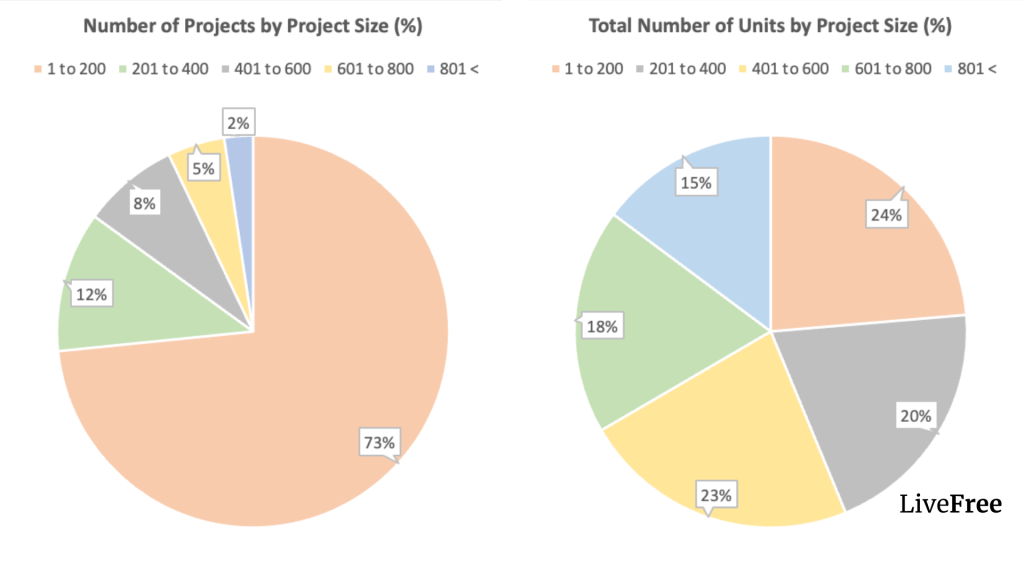
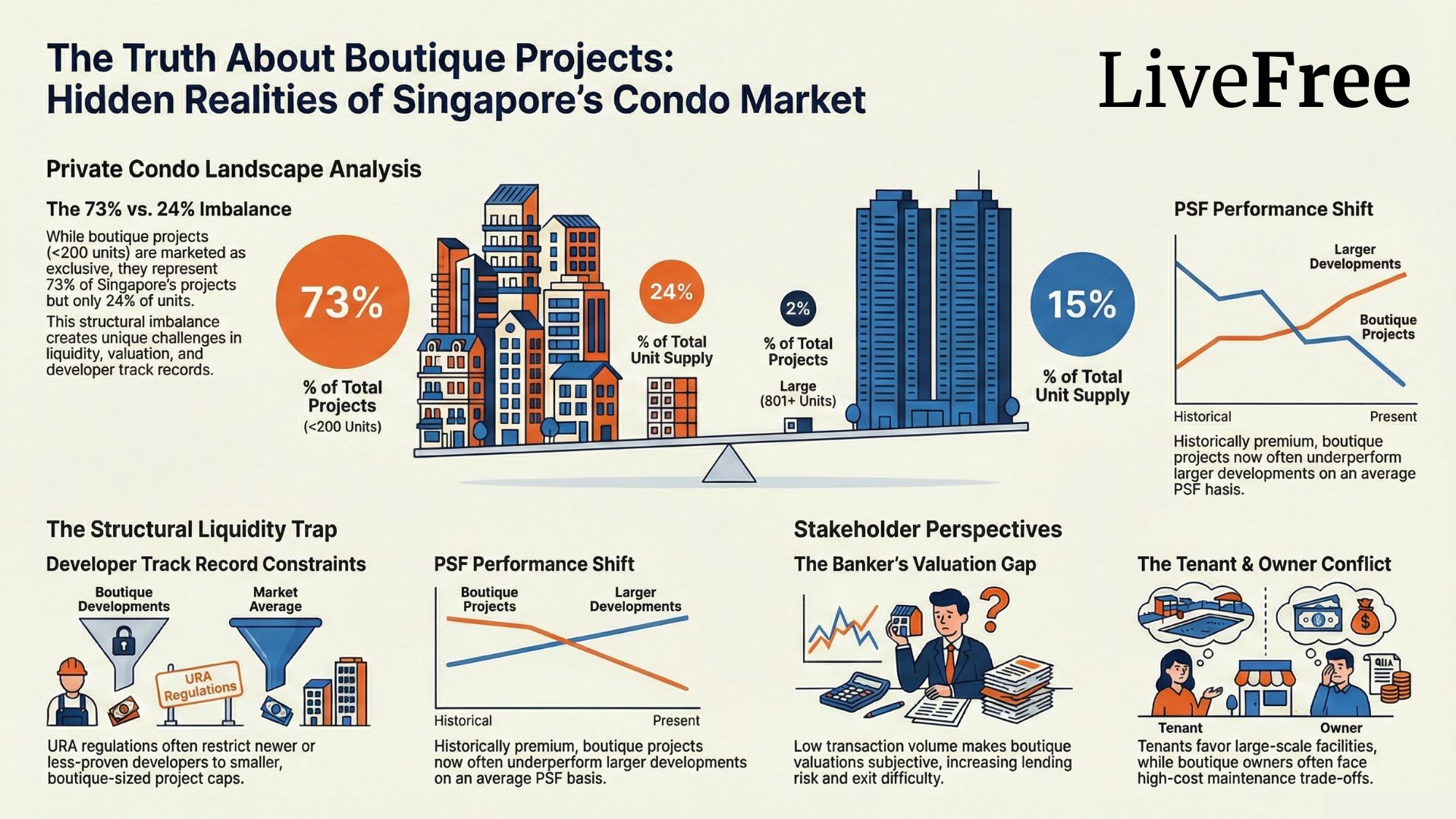
Roughly 73% of private non-landed residential projects in Singapore have fewer than 200 units, yet those projects account for only 24% of total unit supply. At the other end, projects above 800 units make up just 2% of developments but contribute 15% of supply.
That imbalance produces the insight most buyers miss. A boutique condo faces resale competition not because there are too many units in its own project, but because there are too many similarly sized projects nearby, each with its own layouts, design and buyer appeal.
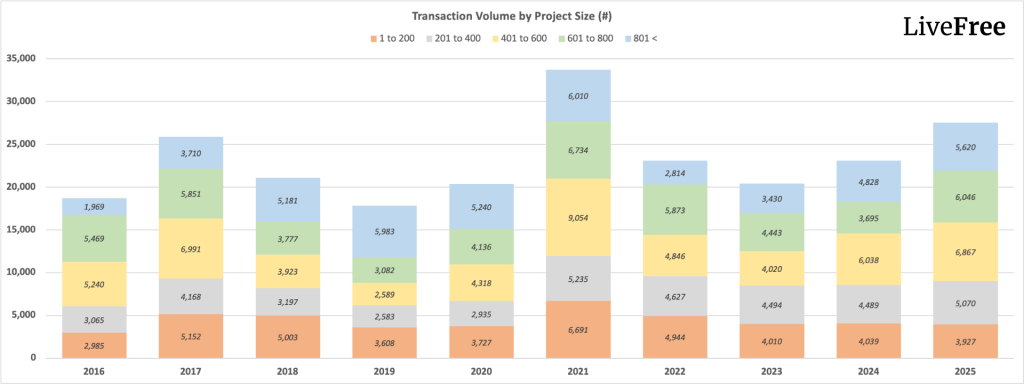
Looked at raw, transaction volumes across all project sizes move broadly in line with overall market activity. Nothing stands out.
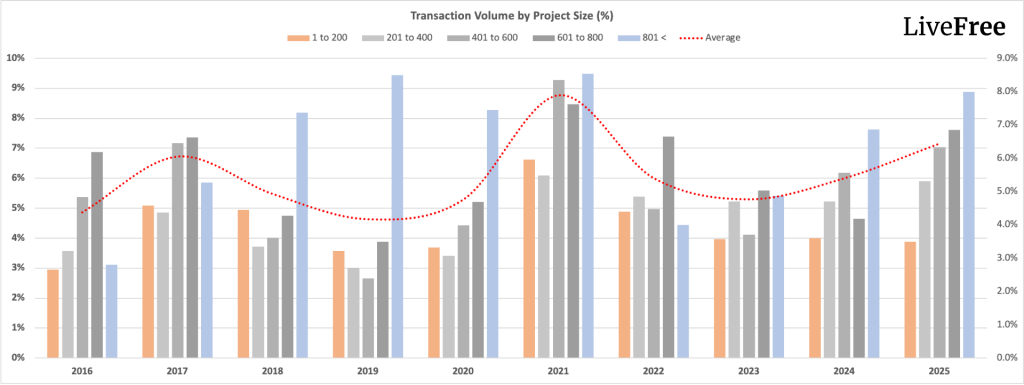
Normalise that volume against total supply and the pattern is clear. Boutique projects consistently record below-market-average transaction volumes as a percentage of total units, while larger projects sit at or above the market average. As a group, a boutique condo is structurally less liquid regardless of where we are in the cycle.
For anyone treating property as a long-term asset, this matters far more than branding. Our ten-year district study shows how much exit liquidity shaped realised returns.
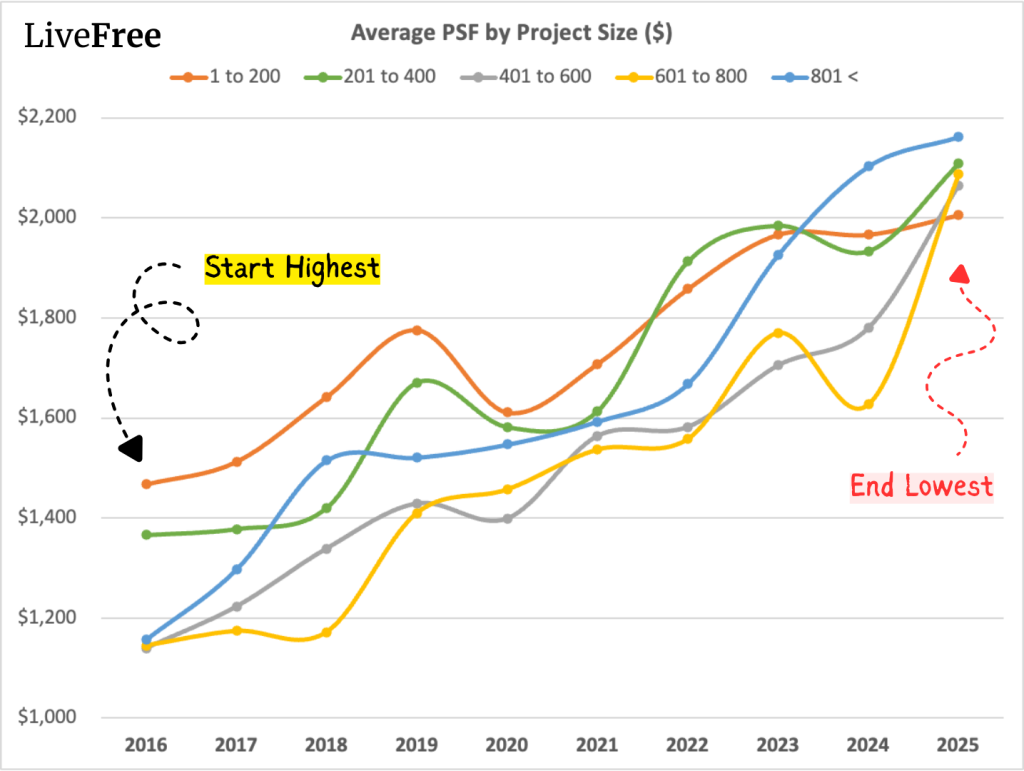
Smaller developments once commanded a premium, usually the luxury boutique projects in prime central locations. Over the past decade that reversed, and boutique condos have underperformed larger developments on average psf.
The reason is structural rather than aesthetic. Larger projects are increasingly located in city-fringe and heartland growth areas, they serve a broader buyer pool led by HDB upgraders, and that consistent demand supports both pricing resilience and resale liquidity.
A boutique condo, by contrast, usually depends on niche demand, which is less stable across cycles. The same dynamic shows up in unit-type demand, which we covered in what ten years of data reveal about condo unit types.
Beyond the raw data, performance is shaped by institutional constraints across everyone involved.

URA regulations introduced in 2016 restrict the size of project a developer can build based on past completion history. Developers with limited track records are capped at smaller projects, and only those with strong delivery histories can build large-scale condominiums.
The BCA CONQUAS framework adds another layer, with lower inspection intensity for developers holding strong quality records and stricter supervision for less-proven players.
The result: large developments are typically built by experienced developers and contractors, while boutique projects are more likely to come from newer or less-established ones. That is not a criticism, but it is a structural reality worth pricing in.
Bankers are not property specialists. They are risk managers. Large developments give them numerous comparable transactions, higher valuation confidence and lower perceived lending risk.
A boutique condo often features unique layouts such as duplexes, roof terraces and patios, with few comparable sales. Valuations become more subjective, which is where gaps open between seller expectations and bank-supported values.
Sellers anchor to past peak prices or to what the home is worth to them. Buyers rely on conservative bank valuations and recent comparables. With fewer transactions to referee the disagreement, negotiations drag and deals are harder to close. This is far less common in larger, more liquid projects.
Management decisions run on share value voting. Landlords tend to prioritise cost control and yield; owner-occupiers prioritise upgrades and maintenance. In a boutique condo with a high landlord ratio, upgrades stall and maintenance standards slip over time. Our guide to condo maintenance fees explains how those decisions get made.
Tenant demand favours MRT proximity, full facilities and established expatriate or professional communities. Many boutique condos sit in low-density private enclaves, which appeals to owner-occupiers but limits rental demand once pricing converges with larger developments. Worth reading alongside our rental yield analysis.
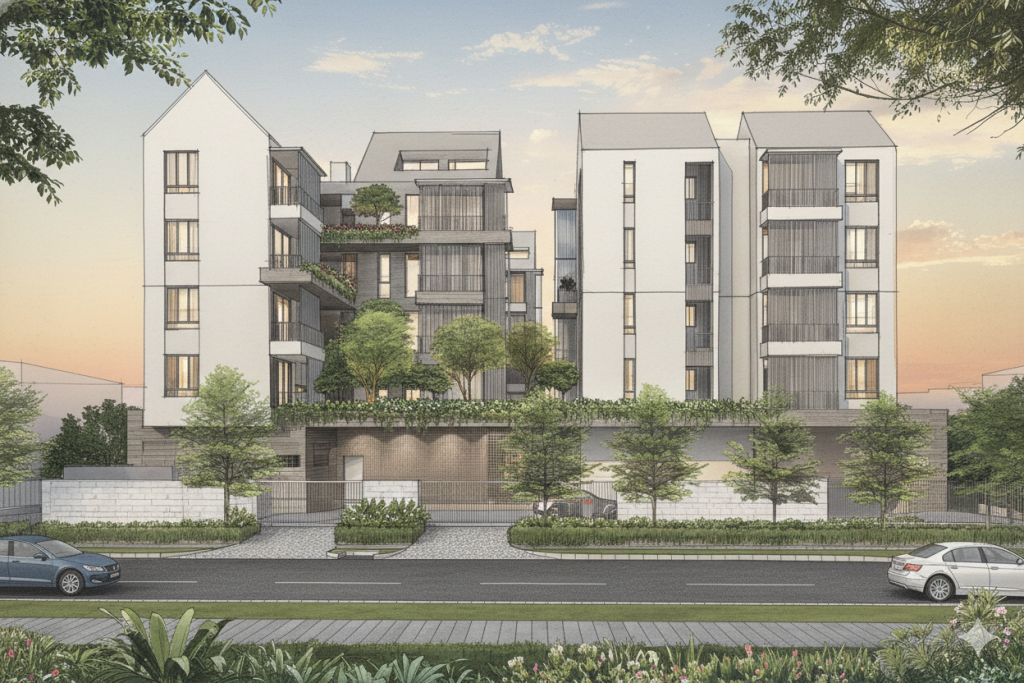
No. Some boutique developments outperform, and they usually share specific traits:
These are exceptions rather than the rule, and identifying them takes more analysis than counting units or reading the brochure.
If you fall into that last group, our HDB upgrading roadmap and the 2026 launch shortlist are the more useful starting points.
The question is not whether a project is a boutique condo. It is whether the project has enough liquidity, valuation support and buyer demand beyond you.
Boutique projects can work. They work when the buyer understands the trade-offs and accepts them deliberately. Tenure is worth thinking through on the same terms, which we covered in 99-year versus freehold, as is the reality that most small projects never see a collective sale, covered in our en bloc data analysis.
A private residential project with fewer than 200 units. The threshold matters because projects below it show measurably different liquidity and valuation behaviour from larger developments.
As a group they have underperformed larger developments on average psf over the past decade, and they are consistently less liquid. Individual projects can still do well, usually when they have doorstep MRT access, a popular school nearby or an irreplaceable location.
Thin transaction volume weakens price discovery, which makes bank valuations more conservative and negotiations slower. A seller anchored to a peak price and a buyer anchored to a conservative valuation can take a long time to meet.
Often, because fixed costs spread across fewer units. The bigger issue is governance: a high landlord ratio can stall upgrades entirely. See our breakdown of condo maintenance fees.
Usually not as a first choice. Tenant demand favours MRT proximity and full facilities, both of which larger developments deliver more reliably. Our rental yield guide sets out realistic numbers, and the 2025 market review gives the current backdrop.
Weighing up a boutique condo against a larger project? Contact Kelvin on WhatsApp — a question costs nothing.
Ask the right question. Not whether it is boutique, but whether demand exists beyond you.
Hi 
We offer private property consultations for readers. Interested?