

The 2026 GLS land bids are the earliest reliable signal of where Singapore condo prices go next. No showflats, no brochures, just developers committing billion-dollar sums behind closed doors. What they pay today sets the launch prices buyers see two to three years later.
In early 2026, four major sites were awarded: Hougang, Dairy Farm, Tanjong Rhu and Lentor. Each says something different about developer confidence, buyer demand and where prices are heading. Full tender records sit with URA.
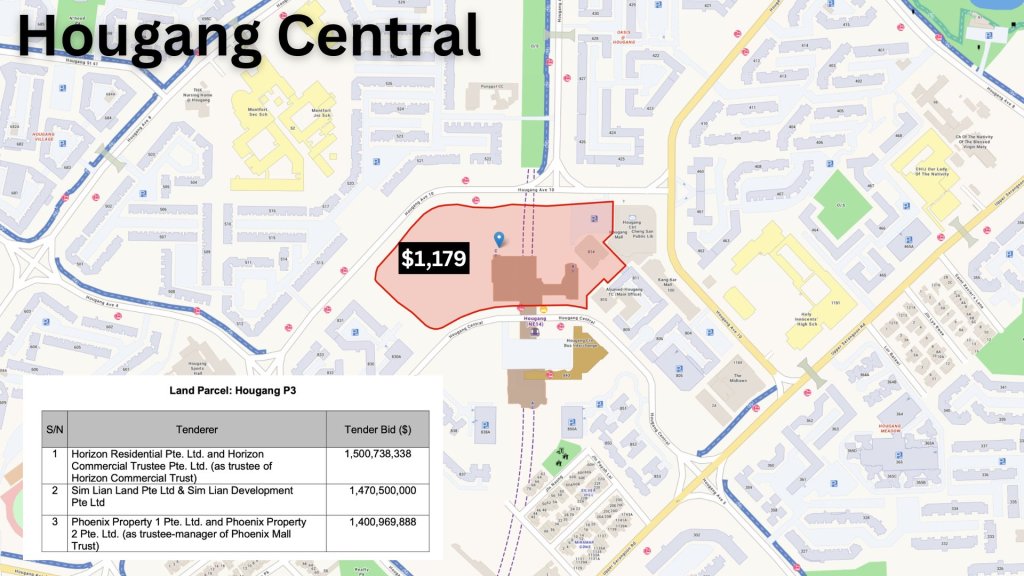
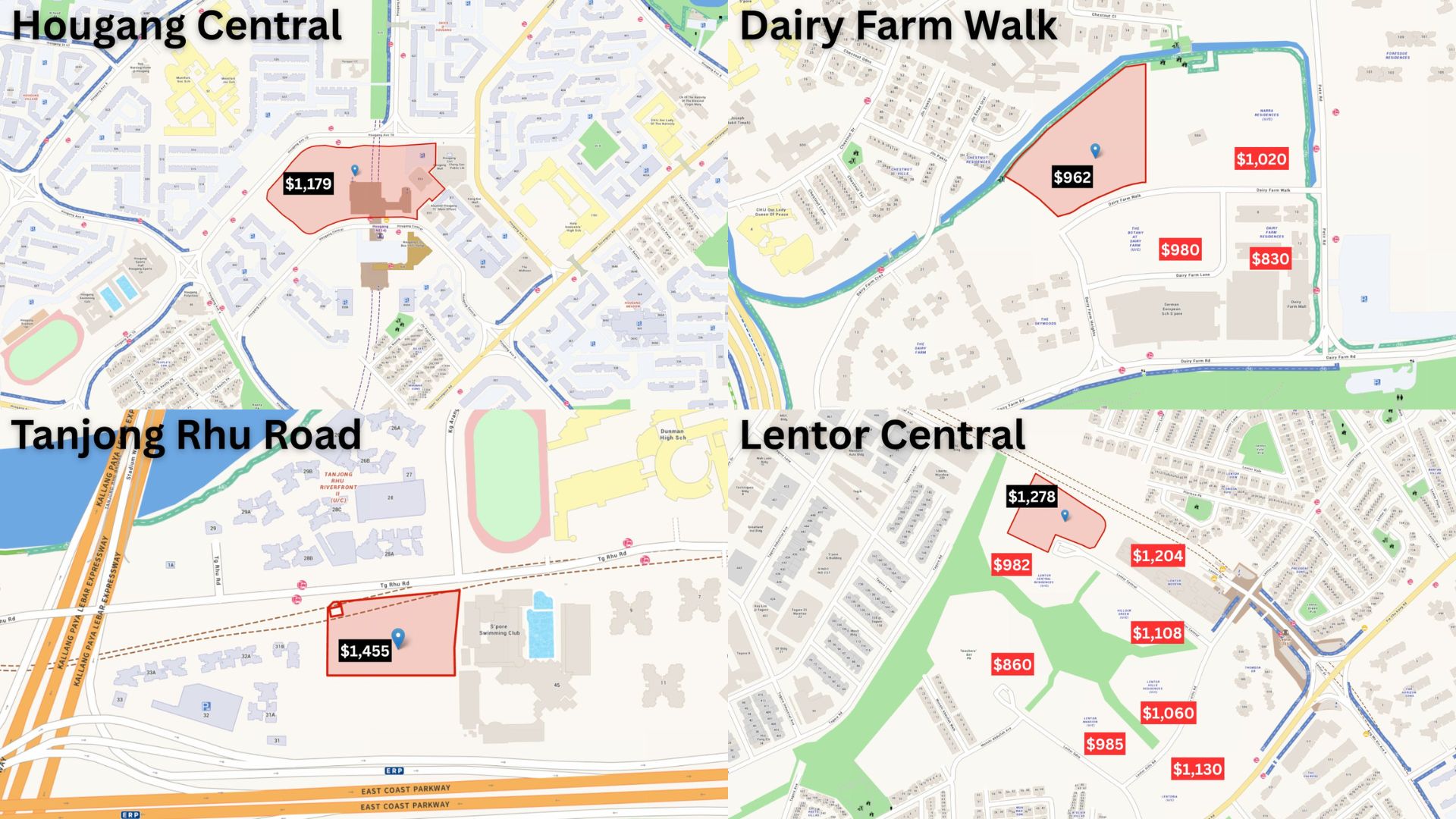
Of the 2026 GLS land bids, this was the largest site and developers paid for it. Three bidders competed, with the winning consortium led by UOL and CapitaLand, both known for large integrated projects. The winning bid was $1,179 psf ppr, beating the second-highest by just 2.1%.
That matters because analysts had estimated the site would land somewhere between $800 and $1,000 psf ppr. It exceeded expectations.
This is not another condominium. It is a major integrated development with around 830 residential units, up to 430,000 sq ft of retail, a direct connection to Hougang MRT, and a new bus interchange and town plaza. It could become the commercial and lifestyle centre of Hougang.
Analysts estimate launch prices starting around $2,600 to $2,700 psf, which would reset benchmarks for Hougang and the wider District 19. Our take: integrated developments have historically been popular, and the fundamentals are strong, but the biggest risk here is overpaying at launch. The neighbouring Chuan Grove launch gives a useful read on District 19 appetite.
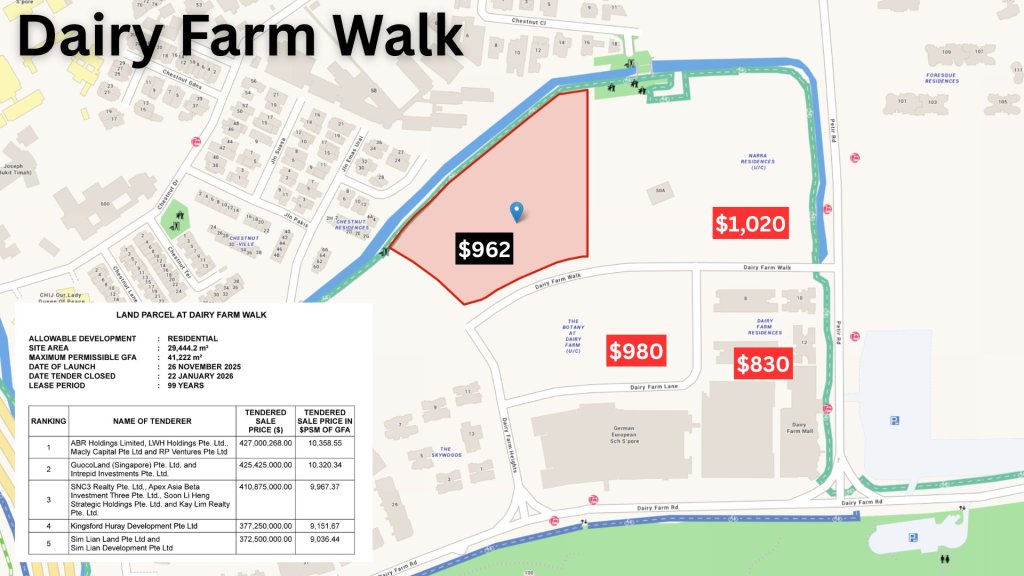
Five bidders competed here, the most of any of the 2026 GLS land bids, and it sold at $962 psf ppr. The land price looks conservative until you understand why.
Developers priced cautiously because of a lower plot ratio of 1.4, sloping terrain that increases construction costs, and height restrictions of four to six storeys. Those constraints make development more complex than a typical high-rise.
What Dairy Farm lacks in connectivity it makes up for in environment. Few neighbourhoods offer this level of nature access, with Chestnut Nature Park, Dairy Farm Nature Park and Bukit Timah Nature Reserve all close by.
Expected launch is around $2,100 to $2,300 psf, competitive with nearby Hillview and Dairy Farm developments. Our take: historically these condos underperform the broader market. Entry prices are attractive but resale moves slowly, because of limited MRT access, fewer nearby primary schools and higher surrounding supply. For long-term owners who love the environment it works well. As an investment, manage expectations, and read our district performance study first.
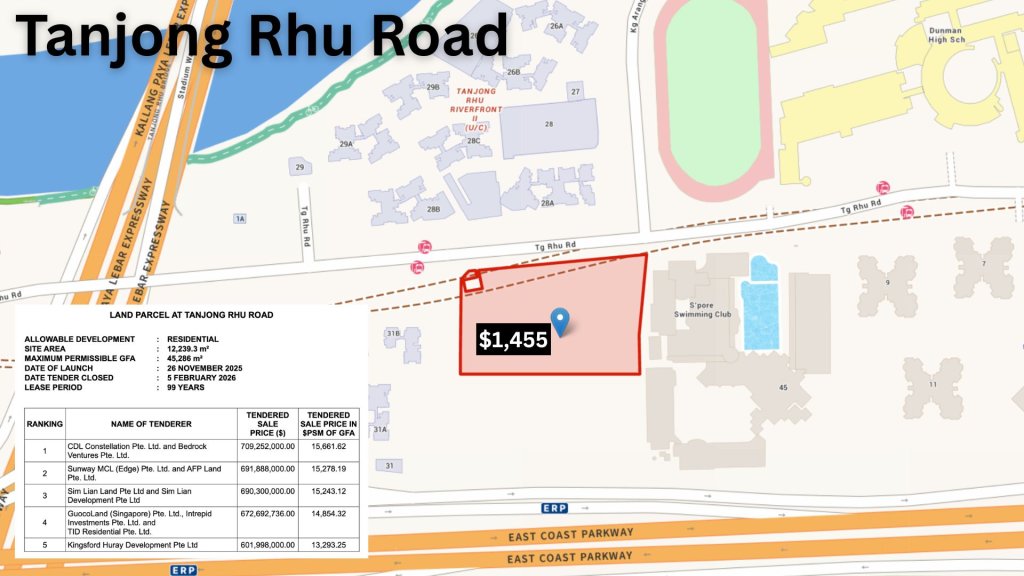
This is the most interesting of the 2026 GLS land bids. The area has not seen a new residential parcel released in nearly 28 years, the last being Water Place in 1997. Developers came in aggressively, and the winning bid hit $1,455 psf ppr, a record for a 99-year site in the Rest of Central Region.
Launch prices could reach $2,900 to $3,100 psf, firmly city-fringe territory. Our take: this is where pricing risk deserves the most attention. At $1,455 psf ppr the land is $100 to $250 psf above many comparable city-fringe sites. There are also limited primary schools nearby, only south-facing units get sea views, and ECP proximity may affect noise. Tanjong Rhu is known for larger luxury units, so a shift toward smaller formats could soften demand. Our District 15 guide covers the surrounding market.
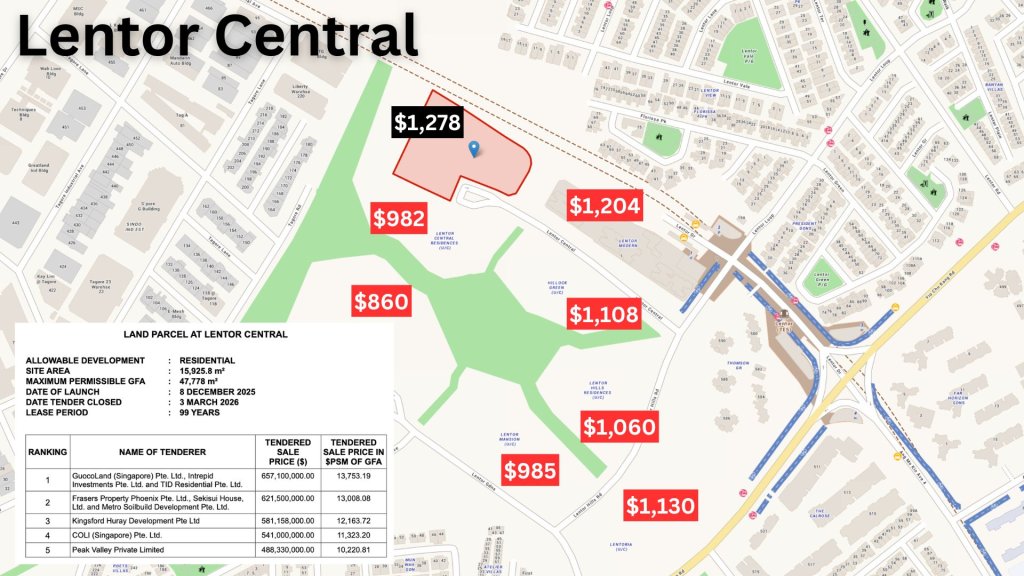
The last of the 2026 GLS land bids went where it usually does. Few developers have shaped a neighbourhood the way GuocoLand has shaped Lentor, turning a quiet landed enclave into a private residential cluster around Lentor MRT. Its winning bid of $1,278 psf ppr sets a new benchmark for the precinct.
Developers rarely double down without the numbers. Across six previous Lentor projects, 2,954 units launched and only 44 remain unsold. That is extremely low inventory for a brand-new neighbourhood, and it says buyers are absorbing supply faster than expected.
Analysts estimate the next project launches between $2,350 and $2,700 psf. Our take: GuocoLand has led Lentor’s identity, but buyers should weigh the trade-off of a new estate. Multiple projects launched within a short window means resale competition later, which is exactly the risk we flagged in our Lentor Gardens review and in the Tengah analysis.
Across the four 2026 GLS land bids, three patterns hold.
Despite cooling measures and higher interest rates, the GLS land bids came in strongly for sites with MRT connectivity, integrated development potential and large upgrader catchments.
Higher land costs today almost always become higher launch prices tomorrow. For buyers on the sidelines the risk is simple: future projects could launch $200 to $400 psf above current levels. That aligns with the thin unsold inventory in our 2025 market review and the narrowing choice in our 2026 launch shortlist.
The strongest bids consistently go to MRT access, large upgrader populations and transformation plans. Those create structural demand that supports prices even in slower cycles, which is the same finding across ten years of district data.
Most buyers start paying attention when showflats open. By then the pricing story is already written, because the real decision happened years earlier when developers bid for the land. The 2026 GLS land bids suggest the next wave of launches is unlikely to get cheaper. The second-half sites are covered in our 2H 2026 GLS breakdown.
GLS land bids are what developers pay when the state releases land. What a developer pays sets the floor for launch pricing two to three years later, which makes the bids the earliest reliable signal of future condo prices.
Of the 2026 GLS land bids, Tanjong Rhu topped them at $1,455 psf ppr, a record for a 99-year site in the Rest of Central Region. Lentor Central followed at $1,278, Hougang Central at $1,179 and Dairy Farm Walk at $962.
Estimates run $2,600 to $2,700 psf for Hougang, $2,100 to $2,300 for Dairy Farm, $2,900 to $3,100 for Tanjong Rhu and $2,350 to $2,700 for Lentor Central.
No. It signals developer confidence, but it also sets a higher entry price for you. Tanjong Rhu is the clearest example: a record land price alongside limited nearby schools and sea views only from south-facing units.
Waiting means paying tomorrow’s prices, and land costs point upward by $200 to $400 psf. Whether that suits you depends on your sequence rather than the market, which our HDB upgrading roadmap and Primary 1 registration guide both bear on.
Wondering what these land bids mean for your timing? Contact Kelvin on WhatsApp — a question costs nothing.
Hi 
We offer private property consultations for readers. Interested?