

The cost of holding your HDB is not the monthly instalment you avoided. In 1990, choosing an executive flat in Jurong East over a three-bedroom condo at Ivory Heights saved $976 a month. By 2025 that decision had cost close to $1 million in retirement liquidity.
Most homeowners weighing an upgrade ask one question: can I afford the higher monthly commitment? That is the visible cost. The full cost of holding your HDB has three layers, and this is the smallest of them.
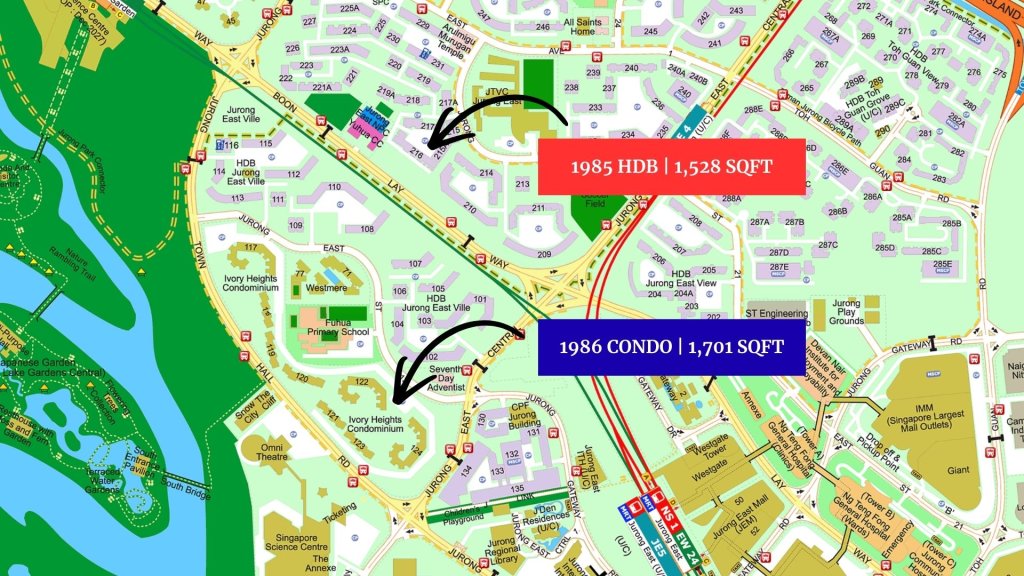
In 1990, executive HDB flats in Jurong East transacted around $180,000 while three-bedroom condos at Ivory Heights transacted around $500,000. Both were large-format homes built in the mid-1980s, both reasonable choices at the time. Even today a three-bedroom condo runs roughly three times the price of an HDB flat of similar location, age and size.
What that difference meant across 35 years is the clearest measure of the cost of holding your HDB we have.
A 1,528 sqft executive HDB at Block 216 Jurong East Street 21:
A 1,701 sqft three-bedroom condo at Ivory Heights:
The difference: $976 more per month, and about $392,791 more in total instalments. This is the cost most upgraders see, and it is why many delay. It is also only the first layer of the cost of holding your HDB. Financing structure changes the picture too, which we cover in HDB loan versus bank loan.
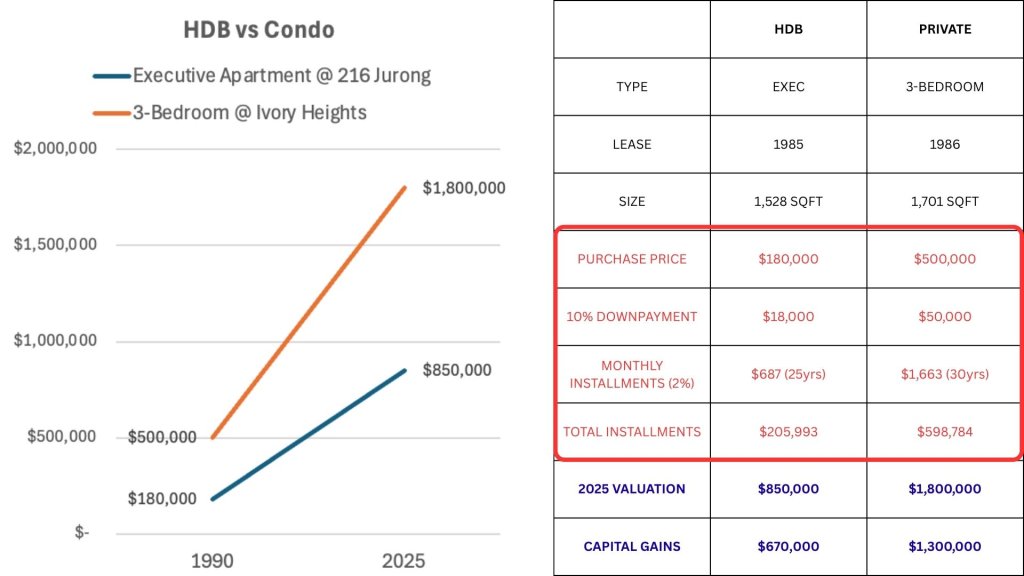
This is where the cost of holding your HDB becomes visible. Fast forward to 2025, both homes fully paid. Recent resale transactions suggest the executive HDB in Jurong East is worth around $850,000 and the Ivory Heights three-bedroom around $1,800,000.
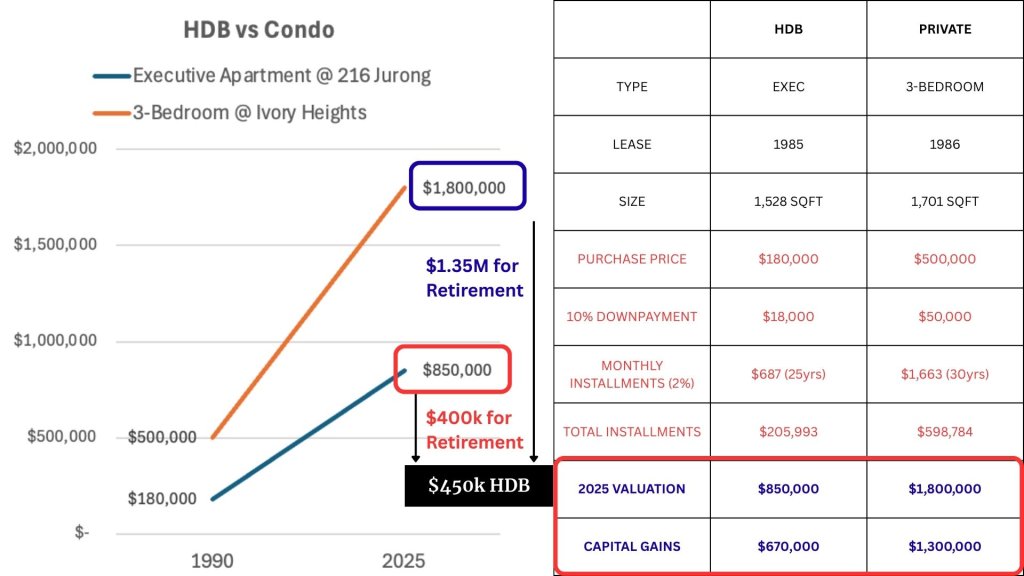
If both owners right-size to a smaller home for retirement, they end up in very different positions. The HDB owner sells at roughly $850,000, moves into a $450,000 three-room flat, and retains around $400,000. The condo owner sells at roughly $1,800,000, moves into the same $450,000 flat, and retains around $1,350,000.
The gap in retirement liquidity is close to $1 million. That buys financial independence, the option to stop working earlier, better medical security and lifestyle flexibility. Upgrading is not only a housing decision, it is a retirement planning decision, and it interacts directly with CPF housing rules and how CPF is used at retirement.
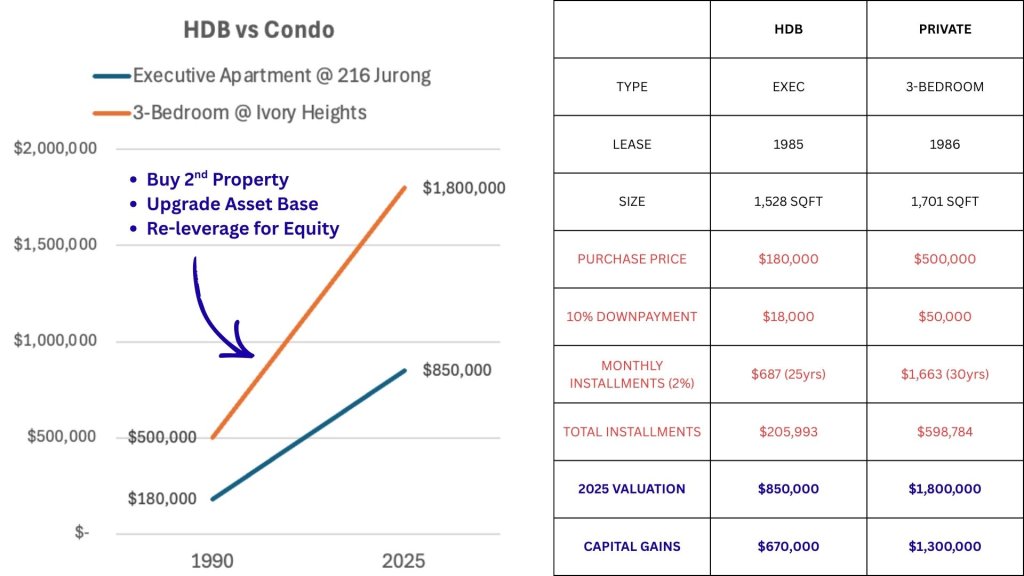
The cost of holding your HDB does not only appear at the end. It compounds along the way. Private ownership allows structural flexibility that public housing does not.
Subject to prevailing regulations, ownership can be structured in ways that may allow a second property without incurring Additional Buyer’s Stamp Duty. Many households use this pathway for long-term accumulation, and we set out the mechanics in upgrading without paying ABSD.
Capital gains can be reallocated into larger or better-located properties, increasing exposure to higher-value segments. Which segments have actually delivered is the subject of our ten-year district study.
Private owners may unlock equity through refinancing, term loans or mortgage restructuring, which creates liquidity during opportunities or crises. HDB owners have no equivalent route.
Owners can rent out the higher-value property and move into a smaller home, generating income while retaining the stronger capital asset. Realistic numbers sit in our rental yield guide.
HDB is primarily a housing solution. Private property functions as both housing and capital vehicle. That is not speculation, it is asset design.

The hidden risk is upgrading too late. As homeowners age, borrowing capacity falls, loan tenure shortens, repayments rise, the CPF runway narrows, risk appetite shrinks, and prices keep appreciating.
A move that is comfortable at 38 can be impossible at 43. The window is not permanent, it is time-sensitive, and that is the part of the cost of holding your HDB that never appears on a spreadsheet. If tenure is part of your hesitation, read 99 year vs freehold before deciding.
The cost of holding your HDB is easy to misread in the moment. That extra $976 a month in 1990 looked expensive at the time. Thirty-five years later it translated into close to $1 million in additional retirement liquidity.
It is reasonable to ask whether you can afford a higher commitment. The better question is what asset position you want to retire with.
HDB and private property serve different roles. HDB gives stability, affordability and a foundation. A condo gives asset mobility and long-term positioning. Neither is better, but they are not interchangeable, which is the same argument we make in property versus stocks. If an EC fits the budget better, our EC upgrade guide covers that route.
If you are approaching MOP or weighing a move, the step-by-step sequence sits in our HDB upgrading roadmap. Timing compounds quietly, and upgrading well is design rather than luck.
On this 1990 to 2025 comparison, the cost of holding your HDB was close to $1 million in retirement liquidity. The HDB owner retains around $400,000 after right-sizing; the condo owner retains around $1,350,000 from the same downgrade.
Monthly, yes. $1,663 against $687, a difference of $976 a month and about $392,791 more in total instalments. The asset gap at the end was roughly $950,000, which is more than double the extra paid in.
Effectively yes. Borrowing capacity falls with age, loan tenure shortens, and instalments rise as a result. A move that works at 38 may not be possible at 43, even on a higher income.
Only under specific conditions, and ABSD applies to most second purchases. Structuring matters a great deal here, so read upgrading without paying ABSD before assuming either way.
HDB resale prices rose 2.9% in 2025 while flats reaching MOP nearly double in 2026, which means more competition among sellers and a narrower launch pipeline. Both sides of that are in our 2025 full-year review.
Working out whether to hold or move? Contact Kelvin on WhatsApp — a question costs nothing.
Ask what you want to retire with. Not merely whether you can afford this month’s instalment.
Hi 
We offer private property consultations for readers. Interested?